When you intentionally enter into space, into silence; and you sit with it, one of the things that begins to happen is that all those things that we keep buried down beneath the crushing weight – the purposely assumed crushing weight – of all the noise and activity in our lives, without any of that there, those things begin to stir. And if we really sit with the silence, they can come up.
Even the mind is going to turn against us. The Monkey Mind starts to chatter, to jam as much stuff, disconnected thoughts, whatever, between us and that silence. But eventually, if you can get beyond it, and you can really begin to work at it – to slip into the silence, those things move. We can find ourselves experiencing old body memories, somatic releases, emotional memories.
And that’s the other thing silence will do for us. It can act as a container. It can act as a vessel. And so those things that now have room to move, and to come up, now, because we’ve eliminated all the external noise – all of the external static – they have room to come out.
So many of us have this idea that we need to go out and save the world. That we need to stop war; we need to stop killing; we need to stop hatred. But honestly, if we just put an end to war, does anybody really believe that it wouldn’t start again? Does anybody believe that if we stopped all the killing, it wouldn’t start again?
I have a Mulberry tree in my back yard that’s one of the most tenacious plants I’ve ever had to deal with, and I respect its tenacity a lot; but unfortunately, it’s threatening a fence, so it’s gonna have to come down. And I have clipped this thing; I have dug away at it; I have used the most environmentally-friendly chemicals on it that I could, and the thing is still there. And the reason it’s still there is because I haven’t dug it out by the root yet.
And so, that’s the thing…
When we gather in our monthly circles and we hold ceremony, sometimes there’s a lot of deep, cathartic release. And one of the things that we’ve learned in working this way – and from teachers who’ve shown us how to work this way – is that when someone is in the midst of something; when they’re in the midst of doing their deep work, if they’re crying, if they’re shaking, you don’t comfort them. You don’t put your arm around them. You don’t tell them they’ll be alright. You sit quietly. You hold space for them. And you let them do their work.
Because so often, we comfort others in their misery, in their sorrow, because we don’t like the way we feel in the presence of that. And so, what we’re really doing is projecting our own pain onto them and trying to heal it vicariously; which is about one of the most selfish things that another human being can do…
I’m sitting out here in a back yard that over the last couple of weeks has really begun to feel almost like my best friend. It’s a beautiful night in September. I’ve got a fire going and I’m sitting out here listening to the crickets.
I’m aware of an abundance of love in my life – in my relationship with my wife, in our community. I have the opportunity to go deep into my healing and my recovery work. And I’m blessed to be able to walk alongside others as they do the same.
And for the first time, maybe the first time in my life, I’m actually aware that I’m worthy of it.
And that might sound like a pretty arrogant thing to say, but the truth of the matter is: when you grow up in a household that’s riven by dysfunctionality, you don’t really get to see a lot of sunshine – when there’s a constant storm of emotional abuse, maybe physical abuse, or sexual abuse, broken up only by these brief moments where the love actually seems unconditional – but that’s nothing more than the eye of the hurricane passing over.
But you latch onto these things. You learn to take them inside. Let them feed you. Let them hold you through the next storm – ‘til the next moment of clarity, the next moment of sanity…
The Pirkei Avot is a collection of theological teachings, maxims, and wisdom from the Rabbinic Jewish tradition. A few years ago, a member of our community passed on a little wisdom to me from that source. We got to talking about service, how we carry ourselves into the world, and what we feel our path is. And he said to me, “it’s important to remember to give from your surplus and not your supply.” It’s a simple statement, but there’s a lot of power behind it. So often, we get caught up in taking care of the needs of others or the day-to-day activities that we forget to take time for ourselves.
This week has been a perfect example of that. I had a lot of chores to do around here; some yard work. I ended up doing quite a bit of yard work over at my Mother in-law’s house. I spent time in the kitchen cooking. I fielded a phone call or two from a friend of mine who was in need.
And I am blessed to be able to do all these things; I enjoy them.
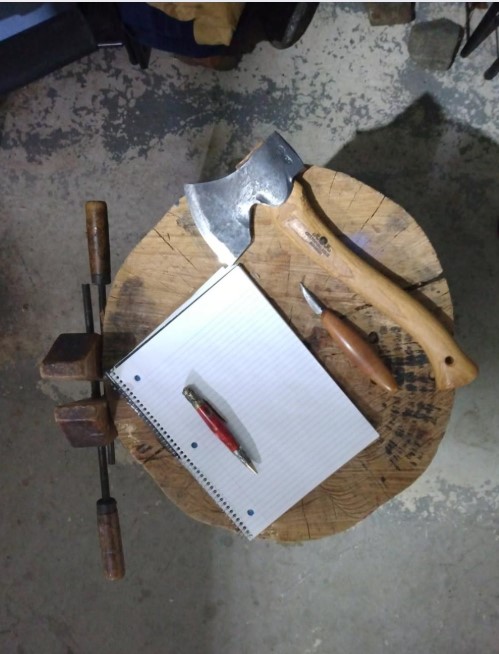
But the truth is, as it got a little closer to the end of the week, I started feeling a little bit ground down; a little bit outgunned. And I realized I hadn’t taken enough time for myself. So, this afternoon, I’m going to be out here in the garage. I’m going to carve a spoon or two. I’m going to listen to some music. I’m going to enjoy this absolutely gorgeous Saturday afternoon…
In certain circles, people will talk about “doing the work.” And we throw that phrase around, and we make the assumption that everybody knows what we’re talking about, but the truth is not everybody does…If I had to define it, I’d say it’s actually got three parts to it, at least as far as I see it: listening, feeling, and reclaiming…
Some people will tell you that empathy’s a gift; that it’s a blessing – you were born with it, and that your job is to walk through this world feeling everybody’s pain and being a healer. Other people like Carl Jung will tell you that it’s a defense mechanism; that’s a skill you learned in order to survive the demands of a dysfunctional household, where knowing the right things to say – or the right things NOT to say – was a skill you picked up in order to avoid pain – maybe even emotional or physical abuse…
Maybe it was ten years ago; maybe it was a little bit longer. I was starting to get the call to step away from the 9-5 world, and into all of this…
I have a teacher who’s fond of saying, “I have a gift, but the power is not mine,” and I make no claims to anything.
All I know is this: If you can find what it is you’re truly here to do, and walk that out into the world; let it shape you, and let it carry you, then that’s just not a gift for you…
When faced with the suffering or ill health of another person in need of prayers or some more immediate form of support, the most caring among us will frequently – perhaps even reflexively – offer to hold space for that individual.
Our hearts might be in the right place, but sometimes our efforts fall short of our intentions, and after a quick prayer, or maybe a phone call or two, we step back and continue on with our lives. That’s fine, of course, if they’re only asking for minimal involvement on our part. But if they’re not, how do we know if we’re really up to the task?
Another way of viewing this is through the lens of “bearing witness”. Typically, this is understood as recognizing the person’s affliction. But how often are we actually willing to go beyond that simple act of recognition and to meet the person where they are, so that we might be able to provide them with the support they really need, instead of what we ourselves deem appropriate?
Yesterday, we gathered for a ceremony in the back yard while most of the rest of the civilized world 9-5’ed. As is generally the case whenever we get together, our focus quickly turned to the state of the world.
Our conversations are usually free-form and heavily seasoned with laughter and wry observations. That’s not to say our ceremonies are unstructured or lack direction. The form is there, though largely marbled through the meat, instead of plastered over it like a cast. There’s a necessary sacredness in coming together with laughter, especially in a world which seems to base so much of its existence upon cruelty, greed, conflict, and fear.
Eventually, we got around to the topic of peace, and how we might bring a little more of it into the world. As a great deal of our work is based upon the Medicine Wheel – or at least the version presented to us in the teachings of Grandfather Joseph Rael (aka Beautiful Painted Arrow) – I attempted to approach the question from this perspective.
The path of the Wheel begins in the East, with the rising of the sun. From there it follows the sun through the sky as it passes into the South, West, and North.
Agriculturally speaking, the East is where the seed is planted.
In the South, the garden is tended. It’s a time of expectation and uncertainty. Will there be too much rain or too little? Will the temperatures run to extremes? Will there be enough food for us all come the harvest? Will we have to deal with insects, deer, or rabbits?
In the West, the questions fall away, and the results are gathered in. We fill the cupboards and begin the necessary preparations to take us through the winter.
In the North, the long, dark time of howling winds, warm fires, and taking stock of the past year’s endeavors, we sustain ourselves on whatever we’ve put aside. If we planted good and healthy crops during the spring, that’s what will feed us as the snow piles up and the windowpanes rattle. If, instead, we’ve planted weeds and thorns, then that will be the source of our nourishment for the winter.
Perhaps, then, the process of peace begins with asking what we’d like to feed ourselves and our loved ones with and simply planting it. We can’t transform the crops once they’re in the ground, but we can learn to pay attention to the seeds we’re sewing.
It’s a blessing to have these things in our lives: fruitful and light-hearted conversations with the Elders of our tribe, an afternoon to sit and write after a morning of errands, pruning the squash vines, and removing the surface rust from a jointer.
Maybe this is how we sew a little peace into our corner of the field…
One of the most difficult and insightful questions we can ask ourselves in the midst of our suffering is, “what have I learned from my pain?” Or to put it another way, “what exactly am I getting out of all of this?”
Approached with deep and unwavering sincerity, questions such as these can serve as a beam of light, cutting through the darkness of our afflictions, and piercing the shadows surrounding the things we’ve long kept locked away; those very things which rise up unseen out of the self-imposed blackness of our shame, guilt, fear, and unworthiness, and grasp the levers of our lives; forcing us to take the actions they deem necessary to ensure they remain obscured and in control.
Questions such as these are dangerous, because the answers they provide can topple the very pillars of our existence. It takes great courage to ask them, and courage equally as great to accept whatever truths they might reveal…