When I get frustrated and the exhaustion sets in, my skin tends to get a little thin…and it did this morning. I’ve learned that when things get like this, it’s usually a sign that I’m pushing too hard. And so, I need to just take some time and rest.
And that’s the thing: rest is also a big part of this recovery process. Learning to sit. Learning to love ourselves enough to take care of ourselves and to just be…to just chill out, breathe, relax when we need to.
To feel these things; not to numb them out, not to stuff them down.
Because running away from our feelings – stuffing them down, hiding from them, not showing them in public – is a lot of the reason that we carry these wounds in the first place…
If you’d like to see more, please check out my podcast, “Putting it on the wind,” on YouTube:
As we get older, if we’re lucky, if we’re brave enough – strong enough – to look at these things from our past, to really, really sit with them, and to examine the consequences as we look out at the wake that we leave behind us through our lives, we begin to realize how we’ve affected others.
And sometimes, the desire to make amends comes about.
Not everybody wants an apology. Sometimes, our apologies are good, true, honest things, and other times, we just want to be left off the cross. But nobody can really do that for us; that’s something we have to do for ourselves.
And so, what’s left, then, is what’s referred to as a living amend: looking honestly at what we’ve done – the effects of our actions – and deciding, “I will not do that again,”
and doing our damnedest not to…
If you’d like to see more, please check out the latest episode of my podcast, “Putting it on the wind,” on YouTube:
Grandfather Joseph Rael teaches us that ceremony begins as soon as you say “Yes” to it. And I really become aware of that about a week or so before our gatherings occur, which they do on the first Saturday of every month. I start to slow down. I start to pay attention to what’s going on inside me, what’s going on in my environment. I start to take a little more notice of what I eat, what I drink, how I move through my day.
And then, as time draws closer, especially on this last day, it really begins to wind up. And the simple chores that we have to do, like putting an extra leaf in the table or taking out the plates and the silverware, getting the crockpot ready for the potluck after the ceremony, raking out the firepit, making sure that we have enough chairs…all those things that go into it, they tend to become more like prayers…
If you’d like to see more, please check out the latest episode of my podcast, “Putting it on the wind,” on YouTube:
As we’re getting down to the last few scraps of 2025, it’s probably a good time to do a little bit of reflecting on what this past year has been like.
Speaking from the perspective of my own emotional recovery – my own spiritual healing – the work’s been pretty difficult, and at times, it’s just been downright exhausting.
But there’s one thing I’ve learned these last many years, and that is, that when you plow deep, you’re going to hit some big stones. It takes a lot to dig them out, but when you do, buried beneath them, you can usually find some pretty good, rich, fertile soil. And that’s definitely been the case this year…
If you’d like to see more, please check out the latest episode of my podcast, “Putting it on the wind,” on YouTube:
I picked up a few requests over the holiday, so I’m out in the garage, cutting some Cherry and Butternut blanks, and getting to work on the initial steps of bringing an antique handaxe back to life.
The heater’s finally taken the edge off the chill, and the workshop’s warm and welcoming; it’s the perfect day to be out here with my tools, enjoying the space that inevitably opens up after the blissful chaos of the annual celebrations.
I’m reminded, in the silence of this space, of the feeling of sitting on the beach when the waves have withdrawn. There’s an openness to it; and a deep and palpable grace that only comes from the knowing and accepting of its impermanence…
As a kid, you walk into a room and you feel anger there…well, you feel angry, so you must be angry. You feel sad, so you must be sad. We learn to internalize those things, to take them on, and to come at the world from the perspective of those things that we’re feeling – believing that they’re our own.
As we get older and lean a little heavier into our work, hopefully, we begin to sort some of that stuff out. We begin to learn what’s ours and what’s not; what we can let go of – what we can hang onto.
And this can be incredibly difficult when we see people we really love going through a tough time. One trap in particular that it’s easy to fall into as someone who’s empathic, is the fix, save, and rescue trap. We see someone suffering, and we want to fix the situation. We want to save them from it; to rescue them from their peril.
Sometimes our motivations aren’t as unselfish as they seem, whether we’re aware of that or not. Part and parcel of growing up in a house full of emotional instability is often the dance of codependence: “I love you because of how you make me feel.”
In the presence of suffering, especially when it’s the suffering of those we care for, we don’t like the way we feel when we see them suffer, and so we want to rescue them; to stop their pain in order to stop our own.
If you’d like to hear more, please check out the latest episode of my podcast, “Putting it on the wind,” on YouTube…
One of the great blessings of my own healing work has been that I have found myself in the presence of teachers who, consciously or unconsciously, have never been afraid to show their humanity. Some of it has been extremely noble, and some of it hasn’t. But the wonderful thing about that, is that I have learned lessons along the way that I could not have learned any other way.
I have gotten to see people being completely human in my presence, and that has opened up space and allowed me to do the same…
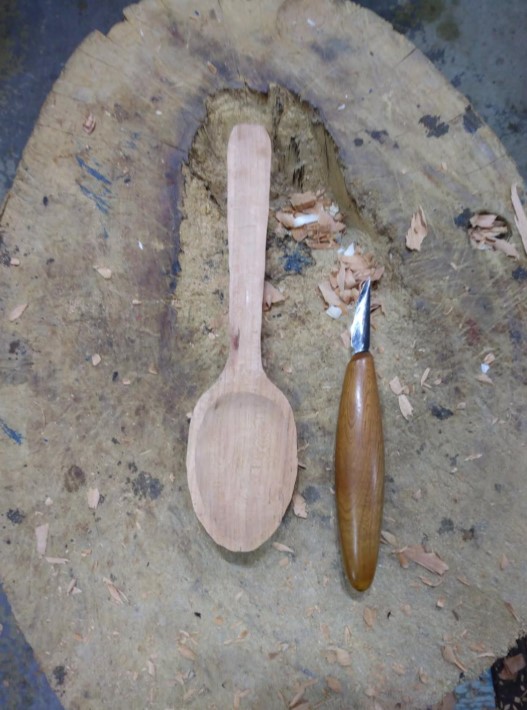
I roughed out a piece of Box Elder this morning. It was the first time I ever worked with it, and the blank was a little bit dry and unforgiving. It was a struggle at first, but somewhere in the middle of things, we reached an agreement.
My brother and I have a saying that we use every now and then: “Christmas in December.” It’s shorthand between us for “business as usual,” or “same shit different day.” He said that in a text he sent me today, which is what got me thinking about it.
Sometimes, you get the idea that things are going to pretty much run to form – that the work you’ve done time and time again will end up being “Christmas in December.” But then, it decides to throw you a curve ball, and best laid plans can quickly turn into a generous portion of “what the hell am I going to do now?”
When this happens, it can either end in failure, or it can give you some insight which you couldn’t have gotten any other way.
Such was the case this morning, when I cut too deeply into the blank, rode the grain, and because it was dry, ended up taking a chunk out of the bowl. I spat out a couple of appropriate Germanic expletives, stared at it for a minute or two, and then I stopped, and let the spoon tell me what to do.
Sure enough, it had a few ideas.
The blank was still pretty thick, so I took my carving hatchet to the end of it, repaired the bowl, now a bit shorter and shallower than I initially intended, and went back to work roughing out the spoon.
It’s drying in the wood chips as I write this. In a few more days, I should be able to fish it out and finish everything up. I’ll approach it a bit more carefully when I do.
As we progress through our healing work, there are parts of us that are going to kick and scream at every attempt that’s made to heal them. They see this work as a fight to the death.
We know that you don’t stop falling until you hit bottom. When that happens, something’s going to shatter. But the only thing that shatters is the lie. That doesn’t mean it’s easy. But that’s what breaks.
And what gets up and walks away, the truth, is a little more healthy than what hit bottom.
Really living through that experience; coming to terms with it and allowing it to be what it is in all its glory: the light, the dark, the love, the hate, the anger, the joy… all of it, that’s really the only way we’re ever going to heal. That’s really the only way we’re going to come through these things and to find the gifts that they carry wrapped inside them…
When you’re a kid, you’re pretty much at the mercy of the environment you grow up in – and the people who inhabit that environment. You can’t pack your fucking bags and move to Podunk when you’re three, that’s just the way it goes.
And so, we learn to adjust.
We learn to eat the food that we’re given. And sometimes, that food comes in the form of some pretty negative beliefs – pretty negative realities. We get told that we’re an idiot. We get yelled at. Maybe we get beaten. Maybe we get emotionally abused, or even worse. We come to find out, sometimes, that the love that we really want is highly conditional and based upon how well we fall in line, or dance to someone else’s music.
As we get older though, we sometimes continue on with those beliefs. We can hear those stories again and again in our heads. And though the voices might sound like the people who said those things – it might even be their words – sometimes, those people have been out of our lives for years or even decades. Maybe they’re even dead.
So, the question is, “Whose voice is it, really…?”

 Bonja the Bodger