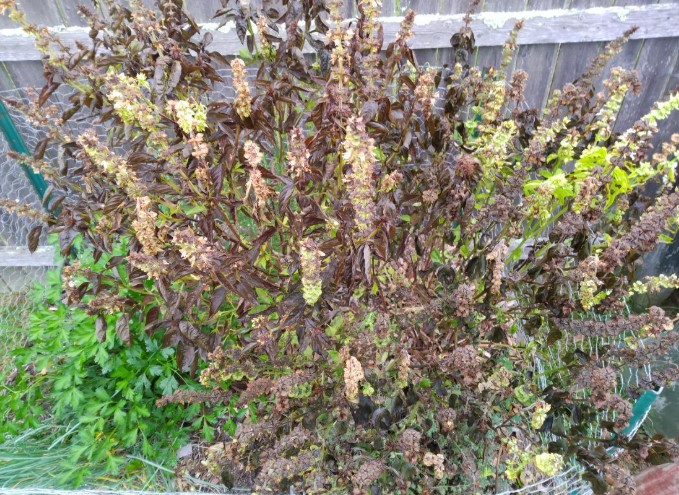
Well, the killing frost has finally taken the Basil.
The tomato leaves are turning black, so I was outside in the garden today doing my best to rescue whatever I could. Our plants were extremely generous this year, so there’s still a lot of unripened fruit on the vines.
I pruned the ornamental apple tree, and cut back the Russian Sage and the gigantic mum in the raised bed in front of the house.
It’s a necessary process, this killing frost; an offering up of what came before to open and sanctify space for what will come.
I’m thinking, as I write this, about a particular dear friend, Elder, and teacher, who, when his time came to step away from ceremony, relinquished his role with humility and grace – one final lesson for those of us ferocious enough to receive it…
There was always something that kept me just on the edge of it. I always felt like I never quite fit in…because the truth of the matter was, I didn’t. But I didn’t know that was because Something much larger than myself was looking out for me. In my own despair, I saw myself as always being just a little out of touch…
Sometimes in this work, we’re not aware of just how strong we really are; nor will we ever be aware of that strength unless we’re called upon to use it.
Other times, we claim strength – we claim power – that isn’t really there. And it’s brittle. And it’s arrogant. And it shatters at the first sign of difficulty.
Whichever the case, we’ll have a clearer perspective based upon how we react in moments of being tested…
I’ve been thinking a lot lately about healing, about manifestation, and about clarity.
One of the things that my wife and I often talk about as being a highlight in our lives is the opportunity that we have to gather with our community once a month for ceremony.
We did that this past weekend. And as things usually go, I got out there about an hour before hand and took some time to walk the yard and pray a little bit, to meditate, and to get things ready. While I was out there, I was greeted by absolutely piercing sunlight, and there wasn’t a cloud in the sky. And with the pristine quality of the light and the openness of the sky, I knew that the intention for our ceremony would be clarity.
Those of us who’ve had a challenging upbringing because we were raised in emotionally turbulent households – maybe with alcoholism or some other form of dysfunctionality, often pray for sanity. But the truth of the matter is, we don’t really know what sanity is. We’ve never really had a good example of it; or perhaps the few examples we have had of it have been fleeting at best.
But we do know what clarity is. It occurs every once in a while. We get to see our wound. Get to see the motivations behind our triggers. Get some insight as to why we act the way we do…
When we gather together in our circles, it’s quite common that people will begin to talk about initiation and the transformations that take place in our lives. And inevitably, one of the metaphors that comes up again and again is that of the butterfly or the moth; creatures that start their lives as one form, go through a huge transformation, and emerge on the other side as something completely different – almost unrelated to the thing that they were before…
I don’t know if the caterpillar envisions the butterfly when it crawls into the cocoon, but it does seem that there is some intangible force that drives the whole thing – that guides the process…
When you intentionally enter into space, into silence; and you sit with it, one of the things that begins to happen is that all those things that we keep buried down beneath the crushing weight – the purposely assumed crushing weight – of all the noise and activity in our lives, without any of that there, those things begin to stir. And if we really sit with the silence, they can come up.
Even the mind is going to turn against us. The Monkey Mind starts to chatter, to jam as much stuff, disconnected thoughts, whatever, between us and that silence. But eventually, if you can get beyond it, and you can really begin to work at it – to slip into the silence, those things move. We can find ourselves experiencing old body memories, somatic releases, emotional memories.
And that’s the other thing silence will do for us. It can act as a container. It can act as a vessel. And so those things that now have room to move, and to come up, now, because we’ve eliminated all the external noise – all of the external static – they have room to come out.
So many of us have this idea that we need to go out and save the world. That we need to stop war; we need to stop killing; we need to stop hatred. But honestly, if we just put an end to war, does anybody really believe that it wouldn’t start again? Does anybody believe that if we stopped all the killing, it wouldn’t start again?
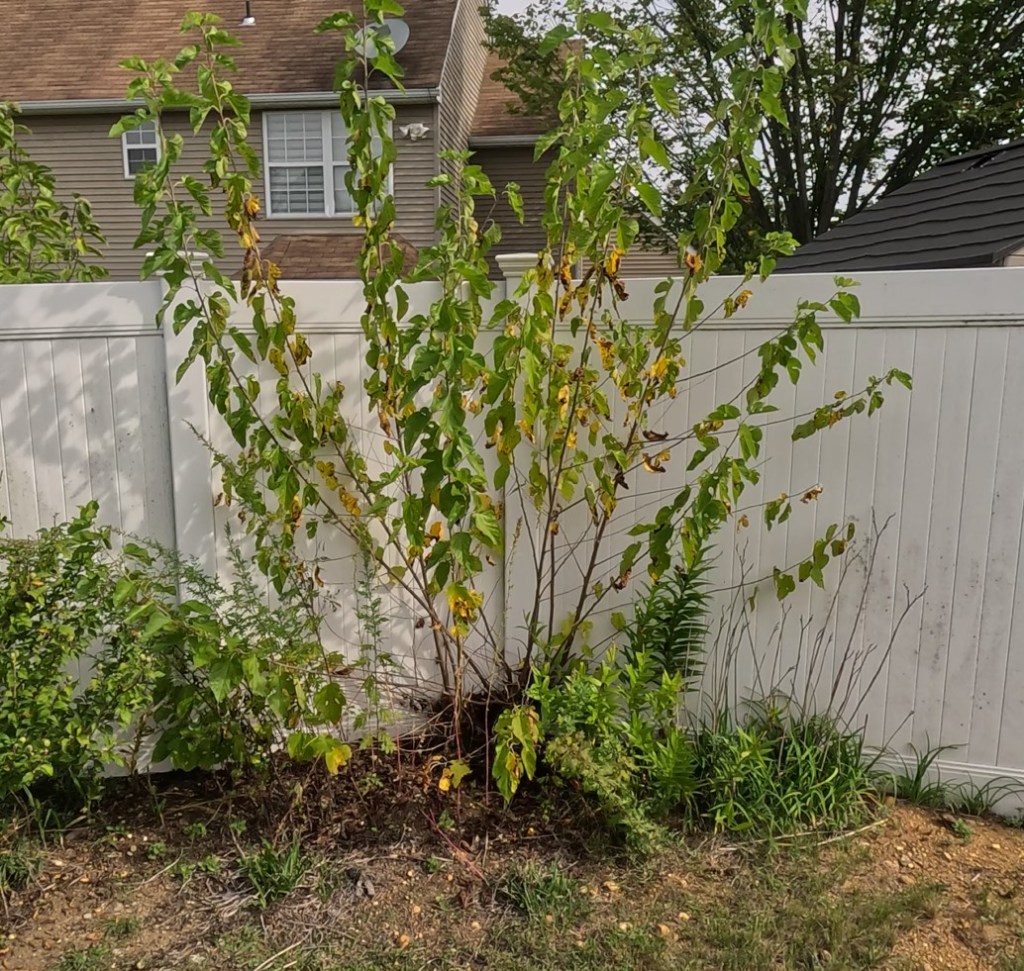
I have a Mulberry tree in my back yard that’s one of the most tenacious plants I’ve ever had to deal with, and I respect its tenacity a lot; but unfortunately, it’s threatening a fence, so it’s gonna have to come down. And I have clipped this thing; I have dug away at it; I have used the most environmentally-friendly chemicals on it that I could, and the thing is still there. And the reason it’s still there is because I haven’t dug it out by the root yet.
And so, that’s the thing…
When we gather in our monthly circles and we hold ceremony, sometimes there’s a lot of deep, cathartic release. And one of the things that we’ve learned in working this way – and from teachers who’ve shown us how to work this way – is that when someone is in the midst of something; when they’re in the midst of doing their deep work, if they’re crying, if they’re shaking, you don’t comfort them. You don’t put your arm around them. You don’t tell them they’ll be alright. You sit quietly. You hold space for them. And you let them do their work.
Because so often, we comfort others in their misery, in their sorrow, because we don’t like the way we feel in the presence of that. And so, what we’re really doing is projecting our own pain onto them and trying to heal it vicariously; which is about one of the most selfish things that another human being can do…
I’ve been thinking a lot about community lately. Standing in the workshop, sharpening my knives, and watching a swarm of bumblebees patrolling the Russian Sage, it isn’t hard to stay connected with this.
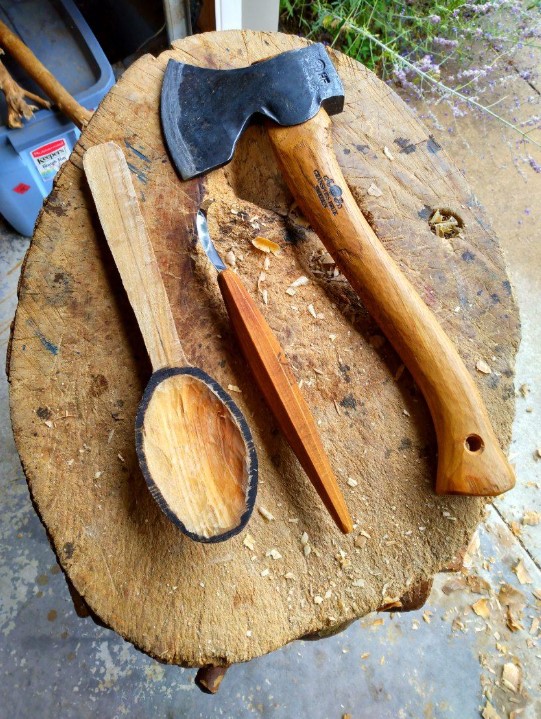
There’s a recognition in ceremony of those who’ve come before – of objects carried by other hands, and words by other voices. Every time I pick up a blank or a billet, and set to work roughing out a spoon, I’m aware of just how many hands besides my own are touching it.
Almost every tool I used today was a Christmas present from my wife or another member of my family. The Butternut was donated. My Carolinas were also a Christmas present. And even my apron came from a box that showed up when my brother in-law dropped off his Shopsmith.
It’s good to be aware of these things. To let them into the work; let them help in the shaping of it. Let them carry it – and be carried by it – from this set of hands to the next…
In certain circles, people will talk about “doing the work.” And we throw that phrase around, and we make the assumption that everybody knows what we’re talking about, but the truth is not everybody does…If I had to define it, I’d say it’s actually got three parts to it, at least as far as I see it: listening, feeling, and reclaiming…
Maybe it was ten years ago; maybe it was a little bit longer. I was starting to get the call to step away from the 9-5 world, and into all of this…
I have a teacher who’s fond of saying, “I have a gift, but the power is not mine,” and I make no claims to anything.
All I know is this: If you can find what it is you’re truly here to do, and walk that out into the world; let it shape you, and let it carry you, then that’s just not a gift for you…
 Bonja the Bodger