One of the great blessings of my own healing work has been that I have found myself in the presence of teachers who, consciously or unconsciously, have never been afraid to show their humanity. Some of it has been extremely noble, and some of it hasn’t. But the wonderful thing about that, is that I have learned lessons along the way that I could not have learned any other way.
I have gotten to see people being completely human in my presence, and that has opened up space and allowed me to do the same…
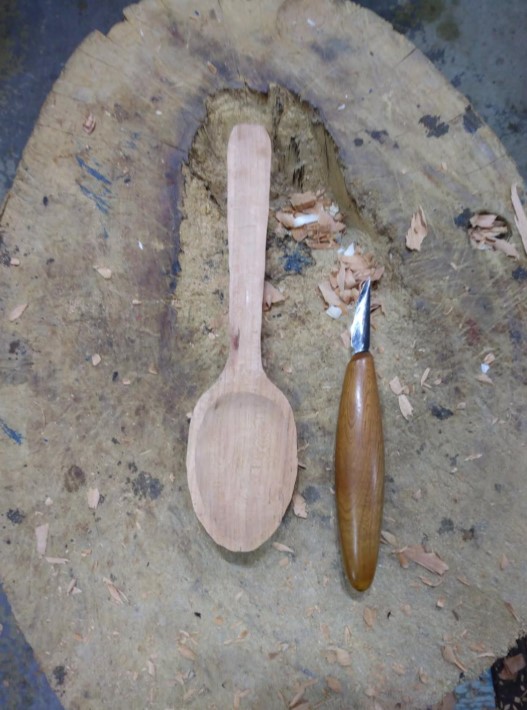
I roughed out a piece of Box Elder this morning. It was the first time I ever worked with it, and the blank was a little bit dry and unforgiving. It was a struggle at first, but somewhere in the middle of things, we reached an agreement.
My brother and I have a saying that we use every now and then: “Christmas in December.” It’s shorthand between us for “business as usual,” or “same shit different day.” He said that in a text he sent me today, which is what got me thinking about it.
Sometimes, you get the idea that things are going to pretty much run to form – that the work you’ve done time and time again will end up being “Christmas in December.” But then, it decides to throw you a curve ball, and best laid plans can quickly turn into a generous portion of “what the hell am I going to do now?”
When this happens, it can either end in failure, or it can give you some insight which you couldn’t have gotten any other way.
Such was the case this morning, when I cut too deeply into the blank, rode the grain, and because it was dry, ended up taking a chunk out of the bowl. I spat out a couple of appropriate Germanic expletives, stared at it for a minute or two, and then I stopped, and let the spoon tell me what to do.
Sure enough, it had a few ideas.
The blank was still pretty thick, so I took my carving hatchet to the end of it, repaired the bowl, now a bit shorter and shallower than I initially intended, and went back to work roughing out the spoon.
It’s drying in the wood chips as I write this. In a few more days, I should be able to fish it out and finish everything up. I’ll approach it a bit more carefully when I do.
As we progress through our healing work, there are parts of us that are going to kick and scream at every attempt that’s made to heal them. They see this work as a fight to the death.
We know that you don’t stop falling until you hit bottom. When that happens, something’s going to shatter. But the only thing that shatters is the lie. That doesn’t mean it’s easy. But that’s what breaks.
And what gets up and walks away, the truth, is a little more healthy than what hit bottom.
Really living through that experience; coming to terms with it and allowing it to be what it is in all its glory: the light, the dark, the love, the hate, the anger, the joy… all of it, that’s really the only way we’re ever going to heal. That’s really the only way we’re going to come through these things and to find the gifts that they carry wrapped inside them…
Amongst the things that get passed down to us from our families – the things that continue to support us, like family traditions or pictures or stories, heirlooms like China, wooden spoons, or upholstered rocking chairs, there are other things that can continue to structure our lives, like fear, shame, and guilt, and some of the darker, more intense stuff like hypervigilance, codependence, or toxic self-reliance.
When you’re raised with dysfunctionality, you learn very quickly how to read the territory. You learn to check the temperature of the air around you. You look for changes in expressions, changes in tones of voice… the slightest clue can give you a read on the environment.
And you learn how to adapt, how to adopt certain behaviors like people pleasing or hiding, never speaking your own opinion but constantly copping to the opinions of others. Or you learn how to constantly challenge authority, to yell back in order to make yourself bigger, so that the threat becomes less.
That was a favorite tactic of mine for many, many years.
These patterns provide a sense of structure and carry us through difficult situations. They can cause us to pick certain types of romantic partners, or repetitive dead-end jobs. They can drive us into reckless spending or self-destructive lifestyles.
Left unchecked, these things can continue to shape the way we live our lives. And so, in their own way, they, too, become family traditions…
There’s been a question that’s come up. And that question seems to be essential to this practice of spiritual and emotional recovery work. And that question is, “Do we have the courage to stand in the midst of the ashes of a life built upon the lies of others, and to allow our truth to express itself…even if we have no idea of what that truth is at the time?”
Not the stories. Not the hopes. Not the ideas of the way things are, or how they should be with us or the world.
Just the truth as it is, without the need or desire for it to be anything else.
This is some of the hardest and most essential work we’ll ever be called upon to do. It can shatter everything. And that’s why so many of us will die without completing it. Sadly, there are a good many of us who will die without ever attempting it in the first place…
…and at this time of the year, when we see the trees that are either bare or on their way there and the leaves on the ground, it’s easy to reflect on those things that have fallen away from our own lives. Some we’ve given up willingly – others have been taken away from us by the strong winds of change: friends who’ve passed through our lives who are no longer there, family members we no longer see or maybe who have died, places we’ve gone, things we believed, ways we’ve acted.
All these things that have come and gone.
Another metaphor that’s reflected upon this time of the year is that of the harvest – the things that we collect, the things that we bring in and fill our cupboards with that nourish us through the long, cold winter.
And while it’s easy to look at that side of it, there is another side to the idea of the harvest, and that’s the things that get left behind. Not only the obvious – the seeds that’ve fallen from the plants, but also the stems and the dying leaves and decaying roots. All those things that once supported the fruits and the vegetables that we’ve harvested, but now get left behind to die and to rot – to get mixed in with the soil to begin to support those seeds that have fallen…
When we grow up in difficult households, sometimes we feel like there’s nobody else in the world that understands us. We spend a lot of time feeling alone. So, when we find another person or people that seem to get us, we tend to cling to that – we put a lot of value in it. Sometimes, we can jump into those relationships full-bore. We can move in, spread out – take up more space than the other party is really willing to allot to us.
We tell ourselves stories about the relationship, about the depth of it. And we build on that, just as we have in the past. And then we operate not from the perspective of the relationship as it really is, but from the relationship as we wish it were – as we perceive it to be because of our need for it to be something else. And that’s a lot to ask of another party.
Sometimes this can be worked out if the person that we’re dealing with is pretty solid. But if not, sometimes these relationships can blow apart because the person – or people – can’t live up to the expectations that we have of them.
Well, the killing frost has finally taken the Basil.
The tomato leaves are turning black, so I was outside in the garden today doing my best to rescue whatever I could. Our plants were extremely generous this year, so there’s still a lot of unripened fruit on the vines.
I pruned the ornamental apple tree, and cut back the Russian Sage and the gigantic mum in the raised bed in front of the house.
It’s a necessary process, this killing frost; an offering up of what came before to open and sanctify space for what will come.
I’m thinking, as I write this, about a particular dear friend, Elder, and teacher, who, when his time came to step away from ceremony, relinquished his role with humility and grace – one final lesson for those of us ferocious enough to receive it…
There was always something that kept me just on the edge of it. I always felt like I never quite fit in…because the truth of the matter was, I didn’t. But I didn’t know that was because Something much larger than myself was looking out for me. In my own despair, I saw myself as always being just a little out of touch…
Sometimes in this work, we’re not aware of just how strong we really are; nor will we ever be aware of that strength unless we’re called upon to use it.
Other times, we claim strength – we claim power – that isn’t really there. And it’s brittle. And it’s arrogant. And it shatters at the first sign of difficulty.
Whichever the case, we’ll have a clearer perspective based upon how we react in moments of being tested…