Like you have to stuff every minute of it with something to do, otherwise you’ll go crazy in the silence; just staring at the walls, living inside your own head.
Or does it feel like solitude?
Does it feel open, spacious…quiet, in a gentle kind of way?
Does it feel like it heals you?
Like it refreshes you; gives you time to be with the things that you’ve lived through on the other side of it…
At the beginning of my own emotional recovery, I was asked one simple question by a person with whom I am still working to this day. And the question was, “Can you just keep putting one foot in front of the other…can you just do that?”
It doesn’t matter what our recovery looks like. It doesn’t matter how long it takes. It’s going to move at its own pace.
And if we’re committed to it – deeply committed to it – we’re going to experience everything.
When you spend your life with people – and you watch them getting older -and you look in the mirror and there’s an old man staring back at you, it tends to put things in perspective.
There’s a certain clarity that’s come with aging. It’s the clarity of knowing what’s important and what’s not; of realizing that the energy that we have is limited sometimes, and it’s up to us where we put it.
But as the wrinkles start coming on – and the hair starts falling off – it gets easier to put that energy into the things that matter, and to let the ones that don’t fall away.
One of the great blessings of my life is that I have found myself in the presence of some absolutely phenomenal people…Elders that I have respected – and continue to respect – to this day.
I have learned so much. I’ve laughed with them. I’ve cried with them. Worked hard. I’ve seen their humanity, and they’ve seen mine,
and they’ve loved me anyway...
One of these elders, someone whom I admire very much, said something one time that really cleared a lot up for me. We were sitting in a circle in a living room, getting ready to do some ceremonial work, and he said, “If any of you have any questions, ask me. Ring me out. Don’t make the mistake of thinking that you’re always going to have me. Don’t even make the mistake of believing that it’s guaranteed that we’re going to be together again…”
Statements like that can be a little unsettling, but they can also be liberating. They can free you from a lot of bullshit, if you’re brave enough to take them to heart…
Have you ever had a moment in your life where something shifted at a really deep level?
Maybe you’re not even sure what it was, but you just felt that change. And you knew that if you said “Yes” to it, that things would never be the same – that there’d be no going back.
And yet, somewhere, deeper down, you also knew that saying, “No” just wasn’t an option…
So, I’ve been spending a lot of time in the backyard lately, taking care of the ceremonial space that our Community uses when we come together on the first Saturday of every month. It needed a little work, so, I’ve been out there doing that, and it’s me taken a couple of days to wrap things up.
At the end of the first day, I was sitting out on the patio, surveying the yard, taking in my work, and as I looked over at that spot, I was hit with the feeling that the energy of the place had shifted dramatically; that the work we’d be doing there would be different from now on.
It would be deeper.
The place felt like it had grown up, like it had become more rooted, become more… solid.
And I also knew without a doubt that I had to say “Yes” to it, and that once I did, there’d be no going back to the way things were before…
Well, seemingly in spite of some of our best efforts, Spring actually came.
The daffodils are starting to open. The hyacinths are pushing their way up through the dirt. The walking onions and strawberry plants in the backyard are really starting to take off.
And the best part is, none of this required a damn bit of effort on my part. It all just kind of happened on its own – the same way it always does…
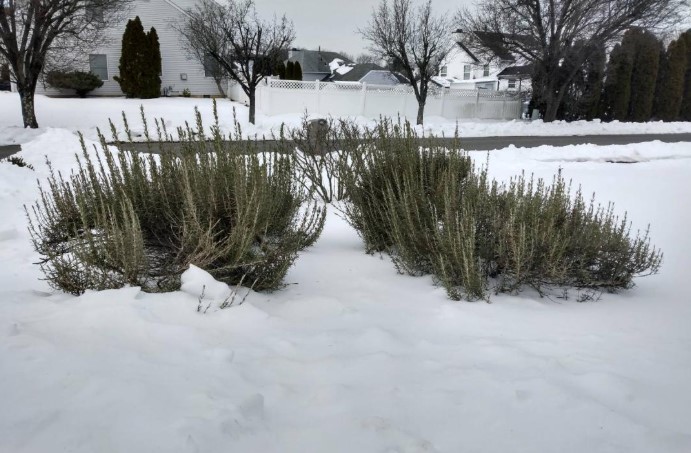
We’re currently in the aftermath of a pretty heavy snowstorm. We ended up with about 12 or 14 inches, and so, I spent most of yesterday outside shoveling us out.
Currently, the temperatures are rising, the sun is out, and the roads and the sidewalks are clean. In fact, they’re almost bone dry. But it’s still going to take a long time for what’s left behind to melt. It’s going to be a good while before we see any green poking up in the backyard.
Looking out at that unbroken field of snow, especially when it’s this deep and heavy, it’s very easy to feel the oppressiveness and the inevitability of it all.
Winter’s a time of dying off – a time of silence, of solitude. And that can be a little hard to navigate for some of us. It’s obvious that we live in a time that’s pretty oppressive. Things are coming at us left and right. They seem to pile up. The world can feel cold and heavy. We can feel alone and isolated.
But there’s another aspect to winter that’s important to keep in mind.
Yes, there is a dying off now, but it’s a necessary dying off. It’s the removal of the old things, the removal of the things that no longer serve. And as those things fall away, they open up space for new growth.
Yes, it’s a time of quiet, a time of slowing down, but it’s also a time of contemplation – of taking stock – of allowing the blessings that we’ve received throughout the year to settle into our bones…
I’m going to ask you two questions right off the bat:
“What are your gifts?”
and
“How are you using them?”
Y’know, it’s pretty obvious that there are forces in the world right now that are doing everything they can to keep us divided – to keep us at each other’s throats – so that they can grab all the power and control that they can. If you look at them closely, you’ll see that their actions come from a place of fear; come from a very, very deep wound. And the results of that wound have been pretty fucking horrific in a lot of cases.
But here’s the thing: in the midst of all of that, it’s also obvious – if you look – that a lot of us are starting to pull together, and come into the world from a place of compassion; a place of inclusivity and love.
Doctors. Artists. Musicians. Social activists. Politicians. So many of us are taking the gifts that we’ve been given, and carrying them into the world to serve the greater good…
Those of us who’ve come up in households where addiction and emotional instability were the order of the day…we know a little something about grieving. We make a partner of our grief. We carry it with us. Often, we carry it down deep, where it hangs there like a feeling we can’t touch.
But sometimes, when we’re tired – when we’re triggered – it can come rushing to the surface. And when it does, it’s good to simply be in the midst of that…
One of the hardest things to do — especially for those of us who’ve carried a lot of pain for a lot of years — is simply to sit with it. Sometimes that pain shows up as body memories, sometimes as emotions or old stories that seem to rise up out of nowhere.
They can get into our heads, start pulling the levers, and before we know it, we can start acting out into the world in ways that might not be too nice.
Today’s a day for knocking out a couple of writing projects. Tomorrow and the day after, we’re looking at windchills of way below zero. That’s far too cold to be out in the shop, when all that stands between me and Siberia is a kerosene heater and drafty old garage door.
So, it looks like a few days of laying low and tending to indoor stuff.
Lately, I’ve really been leaning into letting my life do its thing. I was joking, just the other day, that being retired is actually my job. And after these last few years, I think I finally might be getting the hang of it.
When I was in the 9-5, I really liked having an agenda. It was good to know the what’s and when’s, so I could schedule things accordingly. Now the work is typically catch-as-catch-can.
I won’t lie; it took me a while to acclimate to the shift. Not that my last position was the busiest job in the world. I was a trainer, so there was a lot of hurry up and wait. But I travelled some of the most congested roads in the Metro Philly area, so my days often ended up being pretty long. And I ate up a lot of tires and brakes on that gig.
Now my commute is two small flights of stairs, and the only thing I need to replace is my worn-out bedroom slippers. To be fair, though, I’ve probably gone through 5 or 6 pairs since it all started…
 Bonja the Bodger