I picked up a few requests over the holiday, so I’m out in the garage, cutting some Cherry and Butternut blanks, and getting to work on the initial steps of bringing an antique handaxe back to life.
The heater’s finally taken the edge off the chill, and the workshop’s warm and welcoming; it’s the perfect day to be out here with my tools, enjoying the space that inevitably opens up after the blissful chaos of the annual celebrations.
I’m reminded, in the silence of this space, of the feeling of sitting on the beach when the waves have withdrawn. There’s an openness to it; and a deep and palpable grace that only comes from the knowing and accepting of its impermanence…
It’s the day after Thanksgiving. I stepped out onto the front porch at 4:30 this morning to catch a few breaths, and noticed Orion, prominent in the West – undaunted despite the orange glow of a streetlight in front of our house.
I’d already been up for a couple of hours, but the sky was incredibly clear, so I stood outside a little bit longer, then went back in to brew a pot of coffee.
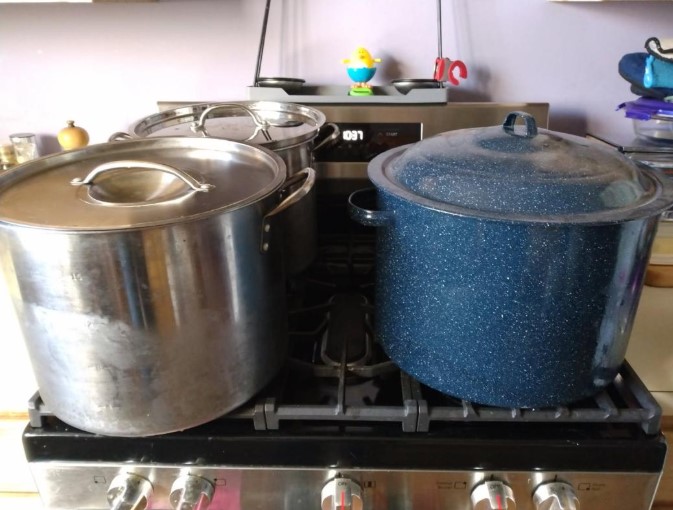
Now it’s a few hours later, and I’m hip-deep into three big kettles of soup stock.
It’s a known fact in certain circles, that I plan on making soup stock every year on the day after Thanksgiving. The family pitches in with turkey carcasses, and my wife and I scrounge up every mushroom stem, onion skin, and vegetable scrap that isn’t composter-worthy. I also collect the juice from most of the meat that I cook, and strain it into ice cube trays.
Each year, preferably on this date, the entire mess goes into as many kettles as necessary, and what follows is a process that’s best described as equal parts alchemy and chaos.
When it’s simmered long enough, I strain everything into a single kettle, and render it down to somewhere between two and three gallons.
The ingredients vary from year to year, so it’s always a mystery until it’s done.
My wife affords me plenty of space, which is either deep consideration or a keenly honed sense of danger on her part. Truth be told, it’s probably a little of both. The first time I cooked in our kitchen, she took one look at my mandala of spices and oils, and an army of bowls filled with various ingredients – all laid out in the order in which I’d add them – smiled, and said, “I’m just going to walk away now…”
It’s been years since then, but as I write this, I’m thinking the exact same thing:
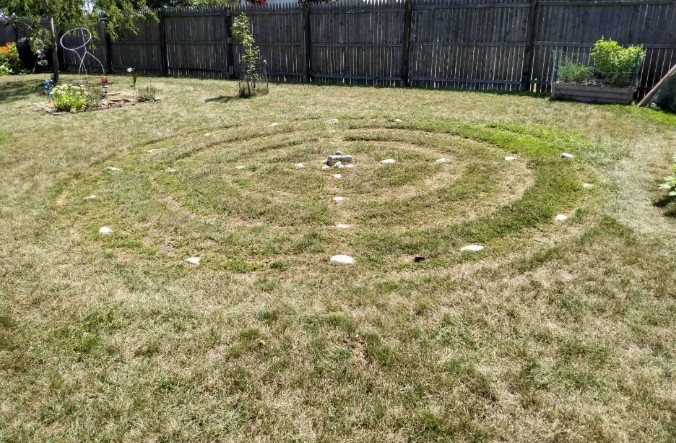
Yesterday, we gathered for a ceremony in the back yard while most of the rest of the civilized world 9-5’ed. As is generally the case whenever we get together, our focus quickly turned to the state of the world.
Our conversations are usually free-form and heavily seasoned with laughter and wry observations. That’s not to say our ceremonies are unstructured or lack direction. The form is there, though largely marbled through the meat, instead of plastered over it like a cast. There’s a necessary sacredness in coming together with laughter, especially in a world which seems to base so much of its existence upon cruelty, greed, conflict, and fear.
Eventually, we got around to the topic of peace, and how we might bring a little more of it into the world. As a great deal of our work is based upon the Medicine Wheel – or at least the version presented to us in the teachings of Grandfather Joseph Rael (aka Beautiful Painted Arrow) – I attempted to approach the question from this perspective.
The path of the Wheel begins in the East, with the rising of the sun. From there it follows the sun through the sky as it passes into the South, West, and North.
Agriculturally speaking, the East is where the seed is planted.
In the South, the garden is tended. It’s a time of expectation and uncertainty. Will there be too much rain or too little? Will the temperatures run to extremes? Will there be enough food for us all come the harvest? Will we have to deal with insects, deer, or rabbits?
In the West, the questions fall away, and the results are gathered in. We fill the cupboards and begin the necessary preparations to take us through the winter.
In the North, the long, dark time of howling winds, warm fires, and taking stock of the past year’s endeavors, we sustain ourselves on whatever we’ve put aside. If we planted good and healthy crops during the spring, that’s what will feed us as the snow piles up and the windowpanes rattle. If, instead, we’ve planted weeds and thorns, then that will be the source of our nourishment for the winter.
Perhaps, then, the process of peace begins with asking what we’d like to feed ourselves and our loved ones with and simply planting it. We can’t transform the crops once they’re in the ground, but we can learn to pay attention to the seeds we’re sewing.
It’s a blessing to have these things in our lives: fruitful and light-hearted conversations with the Elders of our tribe, an afternoon to sit and write after a morning of errands, pruning the squash vines, and removing the surface rust from a jointer.
Maybe this is how we sew a little peace into our corner of the field…

 Bonja the Bodger