Now that the weather has started to break, I’m back to evening walks around the neighborhood.
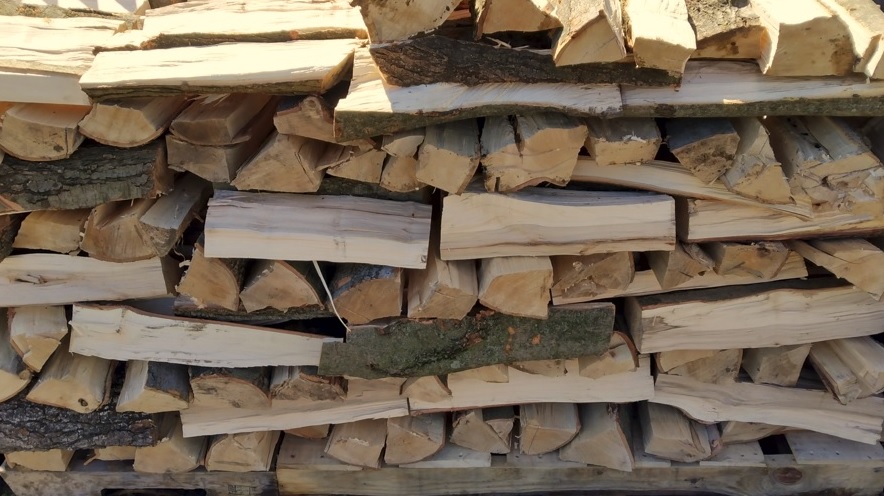
Last night I noticed some pieces of Peach wood buried amongst a pile of branches left by the side of the road after some of the trees in a local orchard had been pruned.
I’ve never worked with Peach before and this is a little bit narrower than I’m used to; but it’s still pretty green, so I’ll billet it up and get it under water until an appropriate project presents itself.
I’m learning to work with what’s in front of me these days; focusing less on outcomes and more on processes. It’s only taken a little shy of sixty-one years to get here. All things considered, I’d say that’s pretty good…
I finally tuned up the kerosene heater and crawled out from under the cold or whatever it was I’d been dealing with for the last two weeks. It feels good to be back in the shop again, putting my tools to use.
I usually try to finish my spoons as soon as they’re dry enough but lately it’s been more about the rough cuts. There’s at least a half a dozen ready to go. They’re waiting – almost patiently – in the wood chips. It’s like they know there’s warmer weather in the forecast, and they’d rather make their first appearance in the open air and sunshine.
So I hunker down and do the work that’s in front of me.
I’m coming to recognize the importance of letting things dictate their own pace and not pushing the river, as it were. The willingness to live this way isn’t something that’s come easy to me for the greatest portion of my life, but I really seem to be taking to it these days…
If some of the conversations I’ve had with fellow spoon carvers are any indication, it seems that more than a few of us have one hanging around their shop somewhere…if not, as in my case, on the wall of their living room. I carved my own rat-tailed bathtub – seen here on the left – just a little over seven years ago. It was January 19th, 2017 to be exact. I know this because I wrote the date on the back of it in pencil and I can still just barely make it out.
Most of my tools were crude and cheaply made. And although I’d had some very generous and patient tutelage from a friend of mine and a couple of veterans online, I’d had no formal training whatsoever. And so I set to work as best I could, slicing away chips of wood and hunks of skin with almost equal fervor.
Compared with one of my more recent spoons on the right, finished just before last Christmas, it’s obvious that the result of my first attempt at spoon carving is as much a victim as it is a product of the external forces that shaped it. And yet I remember being very proud of it at the time. To be honest, I still am in a way. While I could go back and retool it a bit, I prefer to keep it as it is. It reminds me to let the process do its thing; to allow the material and the carving tools to guide me; and to remember that sometimes the spoon itself has the final say as to how it all turns out.
In the years that have followed since that first cold morning huddled next to a struggling electric heater in a cluttered garage that would soon become an only slightly less cluttered woodshop, the number and quality of tools at my disposal has grown. Most, in the vernacular, are “Big BoyTools”, and as one might expect they allow for more refined work. And yet despite their craftsmanship, they are sometimes quick to remind me that without constant attention to the quiet and often demanding voice of the wood itself, they are at heart little more than highly sharpened pieces of steel ready to teach me the importance of that lesson.
There’s humility gained in the unfolding of this work, and a scar or two to mark the achievement of it.
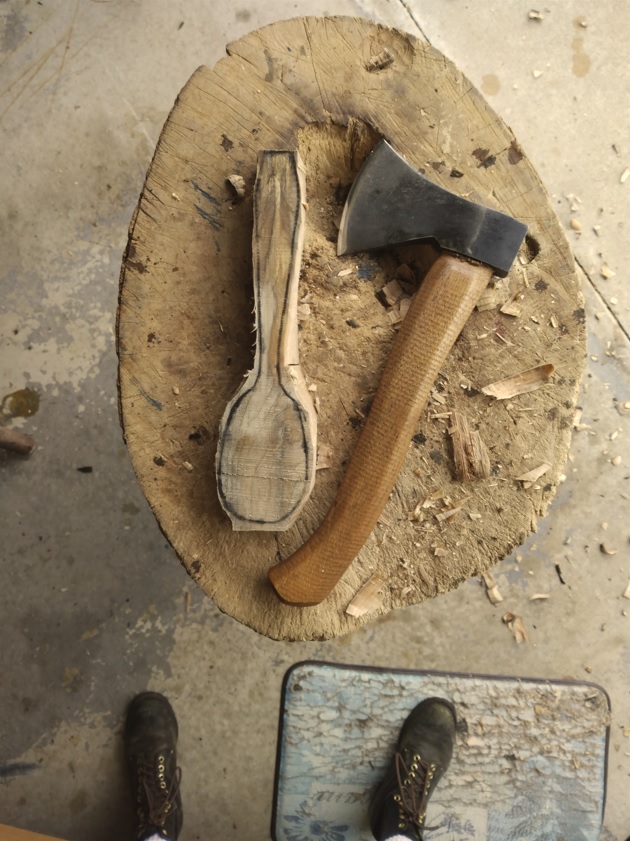
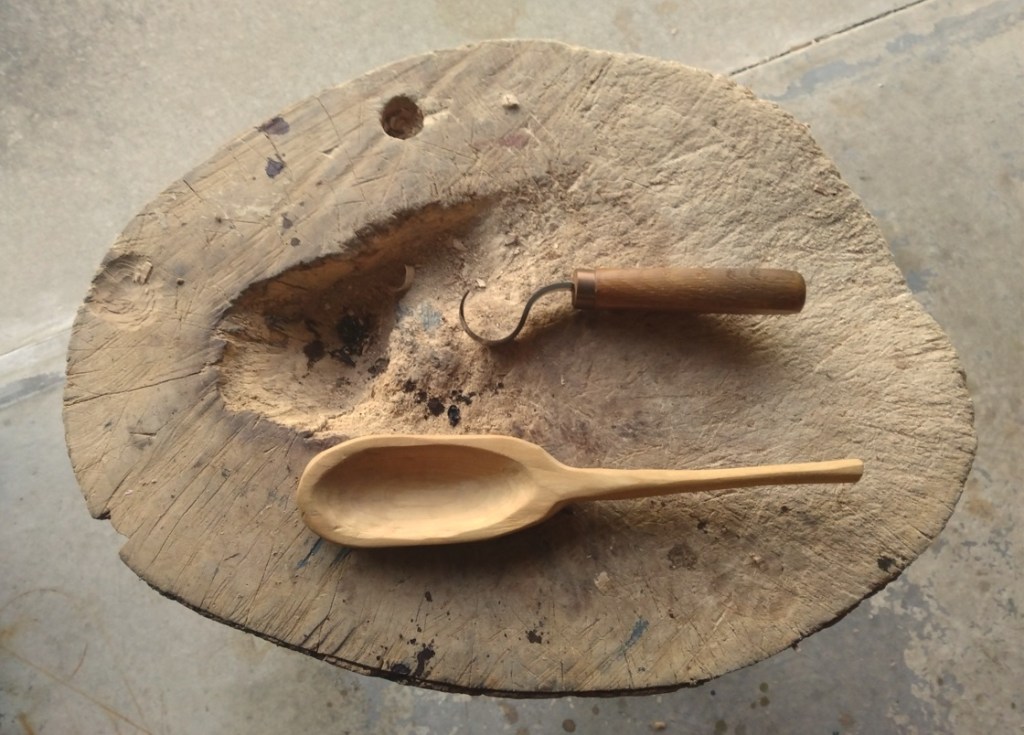
And also there is a sense of continuity. Like the hatchet between the spoons in the picture, the edge of which has touched practically every single spoon I’ve ever carved, there’ s a certain sense of discovery and child-like abandon that has carried everything along from the beginning…
Last night we had our first measurable snowfall of the season; perhaps an inch-and-a-half, perhaps two. It could hardly have been called an event compared with the storms I’d routinely experienced as a child growing up in Northeast Pennsylvania. But even this modest amount serves as a reminder that we are truly in the midst of winter; “the placewhere the White Giant sleeps,” as a beloved adopted Grandfather often reminded us.
In our telling of the Medicine Wheel, winter sits in the direction of the North, the place of childlike innocence and teachability. Traditionally, the long winter was the time to sit at the feet of our elders, to listen to their stories, and to eat the fruits of the past year’s labors while the snows fell and the winds mourned the death of living things. This is a season of reflection and purification, where the old things are broken down or swept aside to feed and make way for the new.
There’s a great deal of Mystery in all of this. Despite our best efforts to shape and define our existences, we can never fully anticipate what will be revealed once the snows recede and the first slender whisps of green emerge.
And yet we feel the pull of it; the arrival of something drawing us towards itself with a force as irrefutable as it is ineffable…
It seems appropriate, considering the traditional perspective of the current season. And yet, it’s an odd feeling to stand at the place where the end of life finds itself so intimately entwined with the beginnings of a new year.
Confluence and conflict: the meat and music of all that is.
I remember showing up for my college classes in my urban combat fatigues, military issue jump boots, black tank top, and cycle jacket that was more pins than leather. I was never actually in the military, but I worked at a surplus store that gave me access to all the gear my meager but steady income could provide. The two most obvious things about myself back then were that my hair was big…and my ego was even bigger.
I’ d enrolled at the University as an English major, and despite looking like a roadie for some bush league hair metal band, I took my education very seriously. I was entering my late twenties, and often years older than a sizeable portion of the other students in my classes. Another thing that apparently separated me from most of the crowd was that I actually wanted to be there. Given the way I looked, and the way I either despised or ignored most of the world around me at the time, this usually surprised the hell out of my teachers.
There was this one professor to whom I took an almost immediate dislike – perhaps because our personalities were so similar, and we both had our own ideas about who was in charge.
I camped out squarely in the front of the class and hit him with as much attitude I could muster. I tested his knowledge repeatedly with questions about the material, and never held back on offering my own insights, which I obviously valued way more than his.
One day after class I was walking down the hall when somebody grabbed me from behind, spun me around, and backed me into a locker. It was the professor, whom I assumed had finally had enough of my shit. He put his finger up to my face, leaned in close, and smiled.
“Don’t ever fuckin’ change, man,” he said. And then he winked and continued down the hall.
From that day on I took every one of his courses that I could, and I frequently caught up with him afterwards in one of the English Department offices to chat. There was still a lot of verbal tennis, but our volleys were directed towards, and not at each other.
For all the impact that hallway encounter had upon me then, it’s unlikely that we’d even recognize each other now, given the thirty-five years or so that have passed since the last time I saw him. And perhaps due to some still deeply residing need to challenge his authority, there have also been a lot of changes along the way…
The intricate patterns and discoloration seen in this Beechwood spoon are the result of a process known as spalting, which occurs when an external fungus growing on the surface of a dead tree sinks its tendrils deep into the fiber of the wood in order to feed itself. Aside from potentially weakening the structure of the wood, spalting also causes the type of patterning displayed here when those tendrils create an armor of protein for protection.
It’s interesting to note that spalting can also occur in living trees experiencing some type of environmental stress. Exposing the wood to sunlight kills the process but leaves behind the colorful and obvious traces of its work. Because of this, spalted woods are highly valued and sought after by artists and woodworkers alike.
Those of us who’ve survived the stresses of growing up in households afflicted by alcoholism, codependency, or some other form of dysfunction often seem to experience a similar process. As children, we’re unable to resist the influences of the sickness in our environment, and so it reaches deep inside us and takes root. It lives there, marking us, and affecting the patterns of our lives in ways which serve to anchor it and keep it fed.
Through our healing and recovery work, we open ourselves up and expose these things to the light of realization. When we do, their influence over us slowly begins to die.
Webster’s online dictionary defines windfall as “something (such as a tree or fruit) blown down by the wind” or “an unexpected, unearned, or sudden gain or advantage.” In reading this, I’m reminded of the horse chestnuts we gathered as children from my friend’s front yard or the hours we’d spend flinging the overly ripened fruit that littered the ground beneath the Crabapple tree that grew in the field across the alleyway behind our houses.
It seems as if a sizeable number of my childhood’s happiest memories are the product of some kind of windfall or another.
The same can be said of my carving, which almost exclusively sources its wood from fallen and donated trees. It’s reassuring to think that the beginning of so many afternoons in the woodshop can be traced back to the generosity of others.
One such benefactor gifted me with the spalted Butternut seen in the picture above. The two days I spent processing the wood yielded three large tubs of billets which are now waiting patiently on the floor of my shop alongside containers of Pennsylvania Cherry, Black Walnut, Sweetgum, and others that likewise ended up there through the agency of providence.
In my spiritual work, I’ve often been presented with the idea of honoring the gift; of discovering what it is we’re here to do, and making the choices that best serve whatever that happens to be. In this way, we shape – and are shaped by – the very essence of our existence.
I hope to remember this whenever I find myself picking up a slab of wood and setting to work on it with one of the many tools I’ve also received as a gift; to take the time to carve in a little bit of gratitude for the generosity that continues to make all of this possible…
There’s a phenomenon I’ve experienced more than once when returning to my carving tools after laying them aside for a while. I’ve noticed that the work seems to flow a little easier; and I’m often surprised to find myself more intrinsically aligned with the natures of wood and blade than I’ve ever been before.
It’s as if that time of apparent rest was simply that…apparent; and although I was never really consciously aware of it, deep down in the marrow some hidden wisdom had settled in and was bubbling its way up towards fruition.
Biologists who study the life cycle of black bears tell us that a mother bear can birth and nurse a litter of cubs while hibernating in her den. Through a process not yet fully understood, she drastically reduces her metabolism; and from that place of mystery, new life emerges and takes hold.
Craftwork and recovery each share a bit of something in common with this.
Those of us who practice either occasionally find ourselves in dark and secret places. The terrain there is often difficult and unknowable, and traversing it requires more than a little faith that somewhere deep in the mystery something powerful and impactful is at work.
While we may not ever see its face or fully grasp its nature, its effects are there, and witnessed in the work of days and hands…
I was gifted with a couple pieces of Plum by some friends of ours whom we visited yesterday for a ceremony honoring the Fall. Plum is a heavier wood, and it’s difficult to carve, even when it’s green. What they gave me seems a bit dry, so it’ll probably end up feeding the band saw instead of a hook knife and hatchet.
Their property is pretty heavily wooded, and by now most of the trees have gotten down to the business of shedding their leaves, so the ground was littered with tatters of red and brown.
So much of this season and the work it involves centers around the release of things which no longer continue to serve us; the allowing of them to drop like dead leaves amid the lengthening shadows of November.
A teacher of mine with whom I’ve worked for the last several years has encouraged me to study the trees during the Fall; to sit and meditate on how easily most will release their burdens to open space for the new growth of the coming Spring. And yet there is that occasional defiant Oak, roots driven stubbornly into the soil, that clings to the skeletal remains of a few dead leaves even as its branches rattle against the frozen tirade of January’s winds.
I wonder how often we have found ourselves hanging onto our old ways with that same Oak-like tenacity, all the while cursing our seeming inability to release them…
But there is also another teaching wrapped inside the fabric of this meditation. Just before they drop their robes and stand shivering and naked before the icy truth of Winter, the trees breathe in every available photon of light and hold it deeply as if to remind themselves that the coming darkness is not a permanent thing; that the light remains even in presence of so much apparent death and decay.
It’s important to remember this; to find those places within ourselves where the light has gathered; and to know that it still remains, even though all apparent evidence of it has crumbled and fallen away in the long, cold, necessary dark of Winter…
There’s something sacred about cooking for a potluck. This is especially true when it involves using a utensil created with my own hands. There’s a feeling that the piece itself is somehow transformed during the process.
It’s kind of a neat idea that a hunk of wood from a fallen tree can find new life and new meaning in the service of others.
When we share the results of our labor with a community, we give away portions of ourselves and receive likewise from those sustained by our efforts. We fortify each other; in essence, become each other – grateful for the opportunity to help one another survive.
An old man in his kitchen turning food into gratitude: this is good work for a Monday afternoon…