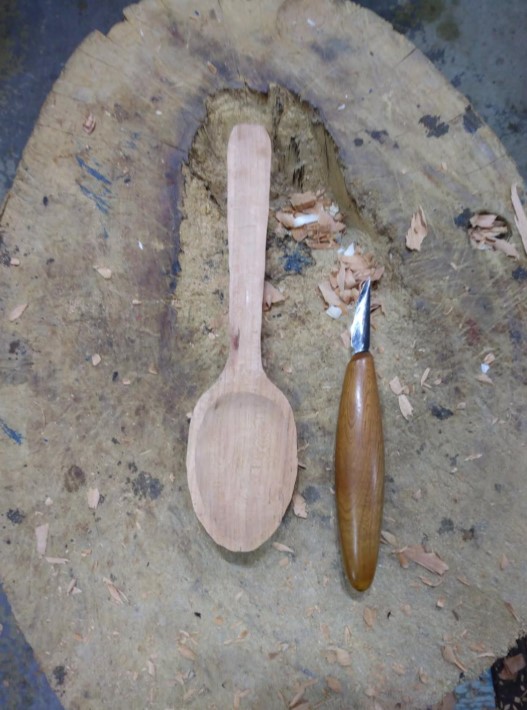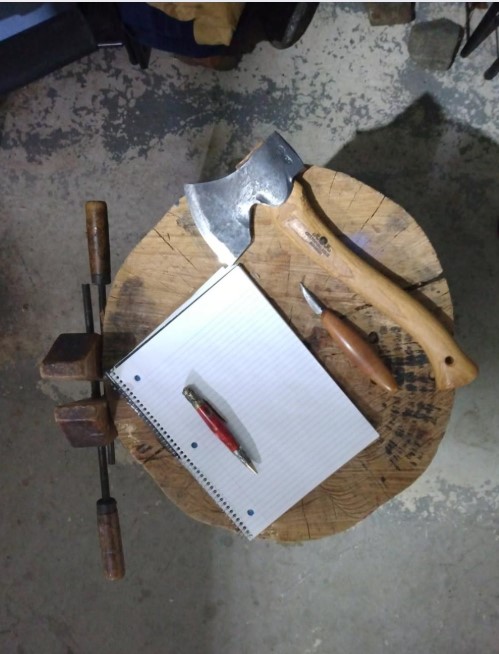
I picked up a few requests over the holiday, so I’m out in the garage, cutting some Cherry and Butternut blanks, and getting to work on the initial steps of bringing an antique handaxe back to life.
The heater’s finally taken the edge off the chill, and the workshop’s warm and welcoming; it’s the perfect day to be out here with my tools, enjoying the space that inevitably opens up after the blissful chaos of the annual celebrations.
I’m reminded, in the silence of this space, of the feeling of sitting on the beach when the waves have withdrawn. There’s an openness to it; and a deep and palpable grace that only comes from the knowing and accepting of its impermanence…
I guess it’s a good idea to go back to the beginning.
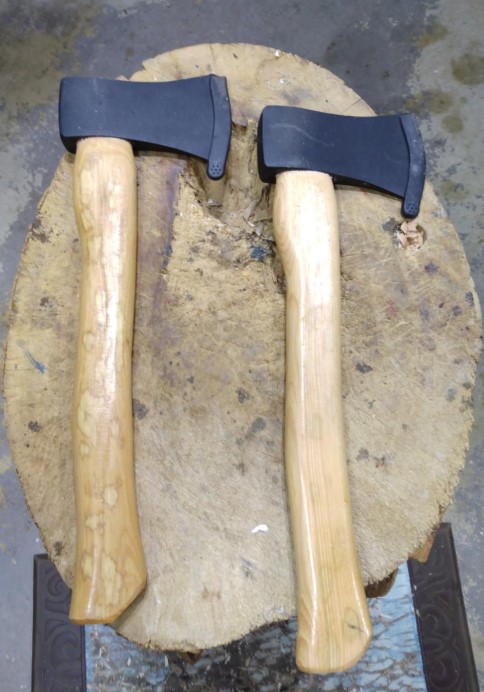
Lately, I’ve been watching some videos on YouTube where a bunch of guys have been touting some inexpensive axes from Harbor Freight. The story goes that with a little tweaking, these bad boys can become a fairly decent camp axe. I’ve always wanted to try my hand at something like this, and at just under twelve bucks a pop, I figured I had nothing to lose.
I won’t go too heavily into the details; there’s a ton of videos out there explaining the process, so there’s no need for me to reinvent the wheel. But the upshot is that the videos I’ve been watching do seem pretty accurate.
Here’s a picture of what I started out with:
First, I removed the stickers and sanded the varnish off the handles. I left them rough to ensure a better grip. Then I drilled each of them out to accommodate a lanyard. I’ll be using paracord for this, but I don’t have any on hand, so I’ll attach the lanyards later, when it comes in.
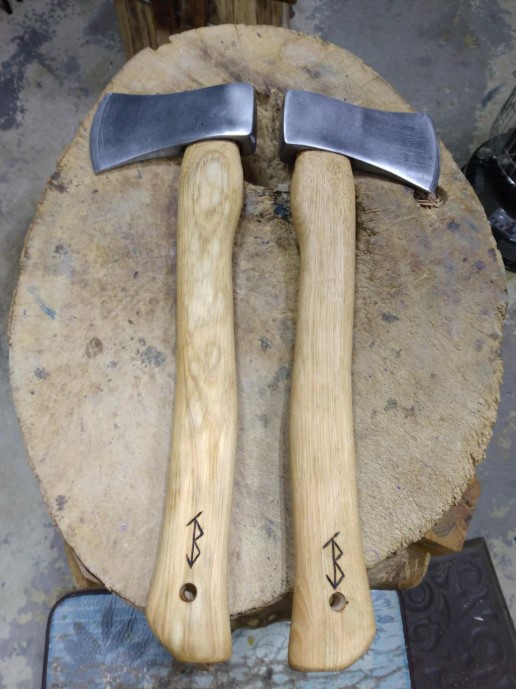
After sanding the paint off the heads of the axes, I got to work reprofiling them with a rag and Bastard file. They were pretty thick, so I thinned them out and lengthened the cutting edges. When that was done, I ran them across some diamond sharpening pads and took them down to 3200 grit.
Once they were sufficiently sharpened, I burned in my maker’s mark and oiled the handles.
They’re drying on my carving block in the workshop, and I’m really looking forward to testing-driving them when I get the chance.
Overall, I’d say it was a pretty good way to spend a Sunday afternoon…
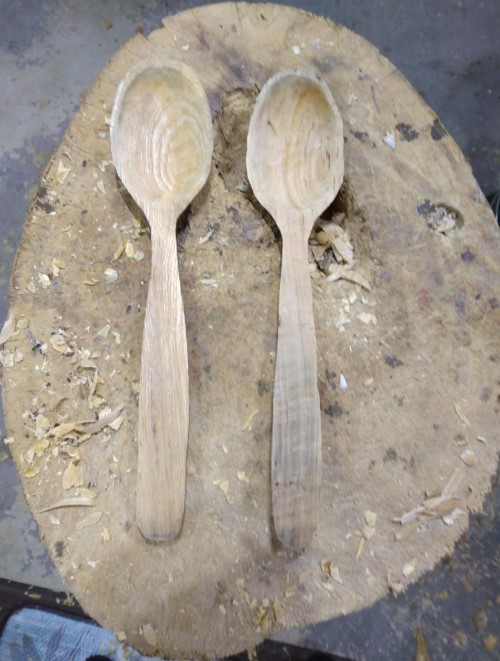
I roughed out a piece of Box Elder this morning. It was the first time I ever worked with it, and the blank was a little bit dry and unforgiving. It was a struggle at first, but somewhere in the middle of things, we reached an agreement.
My brother and I have a saying that we use every now and then: “Christmas in December.” It’s shorthand between us for “business as usual,” or “same shit different day.” He said that in a text he sent me today, which is what got me thinking about it.
Sometimes, you get the idea that things are going to pretty much run to form – that the work you’ve done time and time again will end up being “Christmas in December.” But then, it decides to throw you a curve ball, and best laid plans can quickly turn into a generous portion of “what the hell am I going to do now?”
When this happens, it can either end in failure, or it can give you some insight which you couldn’t have gotten any other way.
Such was the case this morning, when I cut too deeply into the blank, rode the grain, and because it was dry, ended up taking a chunk out of the bowl. I spat out a couple of appropriate Germanic expletives, stared at it for a minute or two, and then I stopped, and let the spoon tell me what to do.
Sure enough, it had a few ideas.
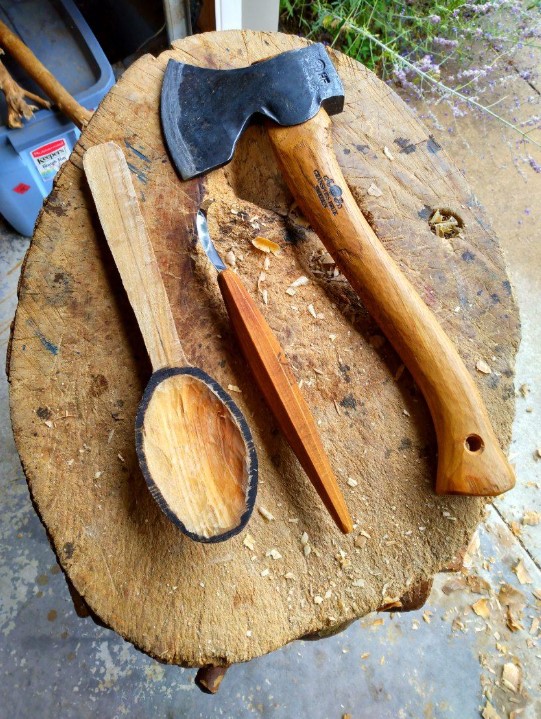
The blank was still pretty thick, so I took my carving hatchet to the end of it, repaired the bowl, now a bit shorter and shallower than I initially intended, and went back to work roughing out the spoon.
It’s drying in the wood chips as I write this. In a few more days, I should be able to fish it out and finish everything up. I’ll approach it a bit more carefully when I do.
I got a request from someone I know to carve some spoons as Christmas gifts for his wife and her sister. He said it would be nice for them to have something to pass down from generation to generation.
And so, it occurred to me that I’ve finally reached the age where someone actually came to me to ask me to create something specifically intended to reach the hands of people I’ll never meet – people who will only know me through my work.
This got me thinking about some of the things that were handed down to me: my father’s anger, my mother’s codependence. My wife and I don’t have any children of our own, so it falls to me to make sure they don’t go any further.
The work’s been long and difficult – a lot more difficult than setting knife to Butternut. It’s a strange thing to find myself in the process of creating new potential heirlooms, while doing my best to remove all traces of a few of the old ones…
How many times in our lives are we handed something that’s perfect as it is – where all we have to do is simply step back and let it be?
I think of my own experiences in carving. Sometimes, I’ll have a spoon that I really love which I’ve worked out of Cherry, or Mulberry, or whatever. And as I stand there looking at it, I think, “Ah, man, I just need to make this one more cut.” And then I do… and it ends up being the one cut too many. Suddenly, I’m left holding something completely different than what it was intended to be.
The same thing happens with my writing. Often times I’ll edit the shit out of something, and what I’m really doing is stomping the life out of it. So, I end up going back to what I originally had, and that thing lives and breathes on its own.
I’ve talked to a lot of people about this process of spiritual healing – of deep emotional recovery work. So often we get bogged down in the fucking weeds with this, and we feel like it’s never going to end. We feel like we’re getting buried.
We have these arbitrary goals that we set for ourselves: the way things should be; the way things need to be. When they don’t line up, we start to blame ourselves. We start to feel as if something is wrong – as if we’re not doing something right.
And that’s really what this whole thing is about. It’s the idea that there’s a process unfolding, and all we can do is show up for it, do the work we’re called to do, not worry about the results, and just let the thing live and breathe on its own…
So many of us have this idea that we need to go out and save the world. That we need to stop war; we need to stop killing; we need to stop hatred. But honestly, if we just put an end to war, does anybody really believe that it wouldn’t start again? Does anybody believe that if we stopped all the killing, it wouldn’t start again?
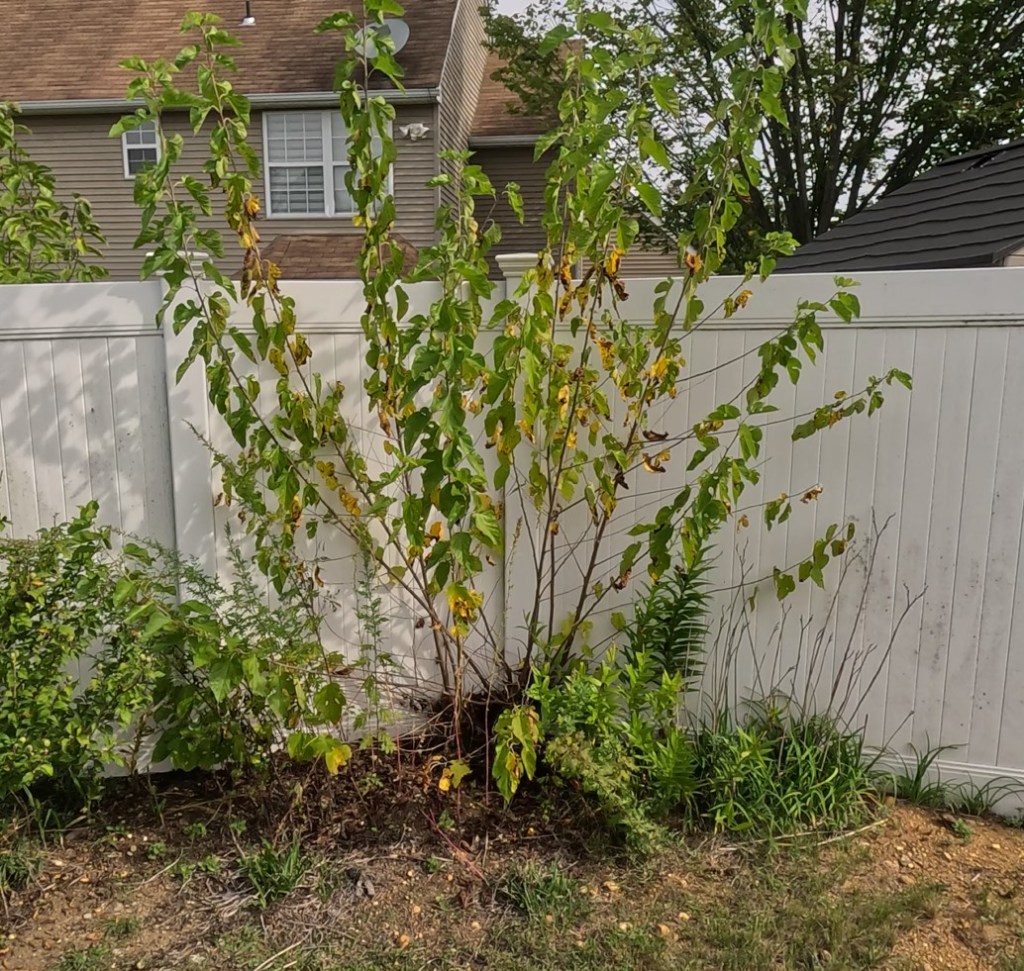
I have a Mulberry tree in my back yard that’s one of the most tenacious plants I’ve ever had to deal with, and I respect its tenacity a lot; but unfortunately, it’s threatening a fence, so it’s gonna have to come down. And I have clipped this thing; I have dug away at it; I have used the most environmentally-friendly chemicals on it that I could, and the thing is still there. And the reason it’s still there is because I haven’t dug it out by the root yet.
And so, that’s the thing…
When we gather in our monthly circles and we hold ceremony, sometimes there’s a lot of deep, cathartic release. And one of the things that we’ve learned in working this way – and from teachers who’ve shown us how to work this way – is that when someone is in the midst of something; when they’re in the midst of doing their deep work, if they’re crying, if they’re shaking, you don’t comfort them. You don’t put your arm around them. You don’t tell them they’ll be alright. You sit quietly. You hold space for them. And you let them do their work.
Because so often, we comfort others in their misery, in their sorrow, because we don’t like the way we feel in the presence of that. And so, what we’re really doing is projecting our own pain onto them and trying to heal it vicariously; which is about one of the most selfish things that another human being can do…
I’ve been thinking a lot about community lately. Standing in the workshop, sharpening my knives, and watching a swarm of bumblebees patrolling the Russian Sage, it isn’t hard to stay connected with this.
There’s a recognition in ceremony of those who’ve come before – of objects carried by other hands, and words by other voices. Every time I pick up a blank or a billet, and set to work roughing out a spoon, I’m aware of just how many hands besides my own are touching it.
Almost every tool I used today was a Christmas present from my wife or another member of my family. The Butternut was donated. My Carolinas were also a Christmas present. And even my apron came from a box that showed up when my brother in-law dropped off his Shopsmith.
It’s good to be aware of these things. To let them into the work; let them help in the shaping of it. Let them carry it – and be carried by it – from this set of hands to the next…
The Pirkei Avot is a collection of theological teachings, maxims, and wisdom from the Rabbinic Jewish tradition. A few years ago, a member of our community passed on a little wisdom to me from that source. We got to talking about service, how we carry ourselves into the world, and what we feel our path is. And he said to me, “it’s important to remember to give from your surplus and not your supply.” It’s a simple statement, but there’s a lot of power behind it. So often, we get caught up in taking care of the needs of others or the day-to-day activities that we forget to take time for ourselves.
This week has been a perfect example of that. I had a lot of chores to do around here; some yard work. I ended up doing quite a bit of yard work over at my Mother in-law’s house. I spent time in the kitchen cooking. I fielded a phone call or two from a friend of mine who was in need.
And I am blessed to be able to do all these things; I enjoy them.
But the truth is, as it got a little closer to the end of the week, I started feeling a little bit ground down; a little bit outgunned. And I realized I hadn’t taken enough time for myself. So, this afternoon, I’m going to be out here in the garage. I’m going to carve a spoon or two. I’m going to listen to some music. I’m going to enjoy this absolutely gorgeous Saturday afternoon…
Yesterday, we gathered for a ceremony in the back yard while most of the rest of the civilized world 9-5’ed. As is generally the case whenever we get together, our focus quickly turned to the state of the world.
Our conversations are usually free-form and heavily seasoned with laughter and wry observations. That’s not to say our ceremonies are unstructured or lack direction. The form is there, though largely marbled through the meat, instead of plastered over it like a cast. There’s a necessary sacredness in coming together with laughter, especially in a world which seems to base so much of its existence upon cruelty, greed, conflict, and fear.
Eventually, we got around to the topic of peace, and how we might bring a little more of it into the world. As a great deal of our work is based upon the Medicine Wheel – or at least the version presented to us in the teachings of Grandfather Joseph Rael (aka Beautiful Painted Arrow) – I attempted to approach the question from this perspective.
The path of the Wheel begins in the East, with the rising of the sun. From there it follows the sun through the sky as it passes into the South, West, and North.
Agriculturally speaking, the East is where the seed is planted.
In the South, the garden is tended. It’s a time of expectation and uncertainty. Will there be too much rain or too little? Will the temperatures run to extremes? Will there be enough food for us all come the harvest? Will we have to deal with insects, deer, or rabbits?
In the West, the questions fall away, and the results are gathered in. We fill the cupboards and begin the necessary preparations to take us through the winter.
In the North, the long, dark time of howling winds, warm fires, and taking stock of the past year’s endeavors, we sustain ourselves on whatever we’ve put aside. If we planted good and healthy crops during the spring, that’s what will feed us as the snow piles up and the windowpanes rattle. If, instead, we’ve planted weeds and thorns, then that will be the source of our nourishment for the winter.
Perhaps, then, the process of peace begins with asking what we’d like to feed ourselves and our loved ones with and simply planting it. We can’t transform the crops once they’re in the ground, but we can learn to pay attention to the seeds we’re sewing.
It’s a blessing to have these things in our lives: fruitful and light-hearted conversations with the Elders of our tribe, an afternoon to sit and write after a morning of errands, pruning the squash vines, and removing the surface rust from a jointer.
Maybe this is how we sew a little peace into our corner of the field…
I spent the morning out in the yard pulling weeds. I’m a lackadaisical weeder at best, but they’d finally gotten to the point where I could no longer convince myself they were “helping the garden.”
After a few hours of that, I grabbed a quick lunch and sat on the front porch covered in dirt, drinking coffee and watching some honeybees working the Russian Sage.
The neighborhood was traffic, crows, and thunder.
As I write this, there’s a slight breeze, a quickening rain, and a tornado warning for the next half-hour or so. But the cat is sleeping comfortably, and the air is full of birdsongs, so at least for now, it appears that we’re okay.
My intentions are to get back out there and cut the grass once everything blows through. That’ll probably take another hour or two, so I’m content to sit here typing away, listening to the rain and the rumble of the thunder.
When I was a kid, thunderstorms used to terrify me. I remember wrapping a pillow around my head so I wouldn’t be assaulted by the noise. Now, the fiercer they are, the more I love them. Apparently, there are some things in life we begin to make peace with as we get older…