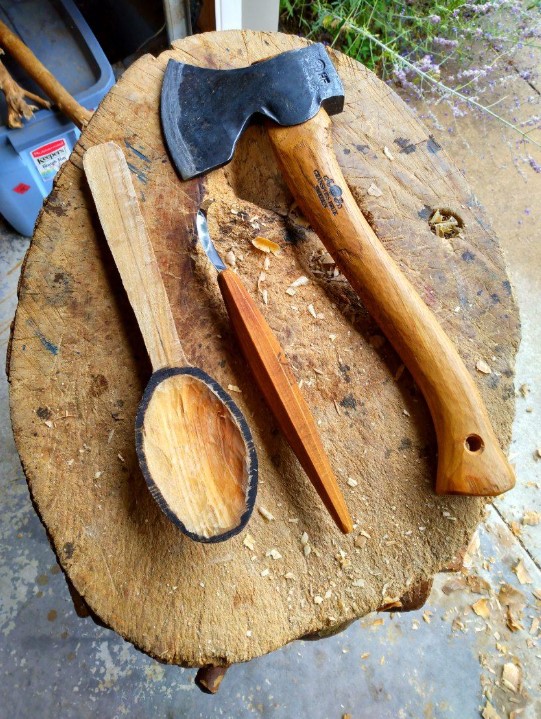
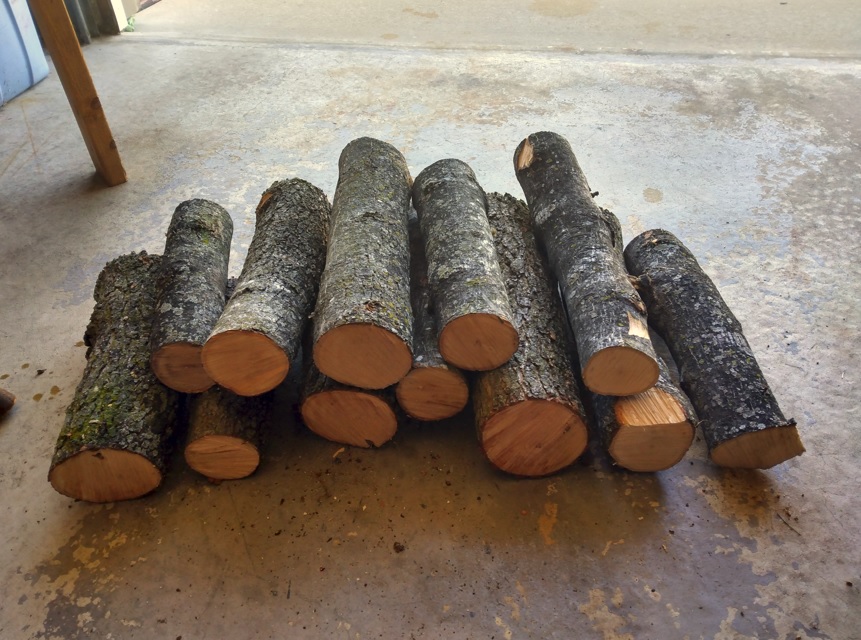
I picked up a few requests over the holiday, so I’m out in the garage, cutting some Cherry and Butternut blanks, and getting to work on the initial steps of bringing an antique handaxe back to life.
The heater’s finally taken the edge off the chill, and the workshop’s warm and welcoming; it’s the perfect day to be out here with my tools, enjoying the space that inevitably opens up after the blissful chaos of the annual celebrations.
I’m reminded, in the silence of this space, of the feeling of sitting on the beach when the waves have withdrawn. There’s an openness to it; and a deep and palpable grace that only comes from the knowing and accepting of its impermanence…
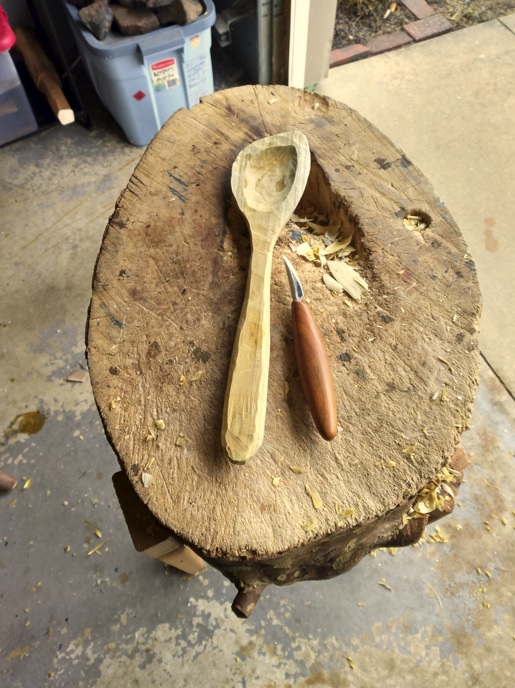
I roughed out a piece of Box Elder this morning. It was the first time I ever worked with it, and the blank was a little bit dry and unforgiving. It was a struggle at first, but somewhere in the middle of things, we reached an agreement.
My brother and I have a saying that we use every now and then: “Christmas in December.” It’s shorthand between us for “business as usual,” or “same shit different day.” He said that in a text he sent me today, which is what got me thinking about it.
Sometimes, you get the idea that things are going to pretty much run to form – that the work you’ve done time and time again will end up being “Christmas in December.” But then, it decides to throw you a curve ball, and best laid plans can quickly turn into a generous portion of “what the hell am I going to do now?”
When this happens, it can either end in failure, or it can give you some insight which you couldn’t have gotten any other way.
Such was the case this morning, when I cut too deeply into the blank, rode the grain, and because it was dry, ended up taking a chunk out of the bowl. I spat out a couple of appropriate Germanic expletives, stared at it for a minute or two, and then I stopped, and let the spoon tell me what to do.
Sure enough, it had a few ideas.
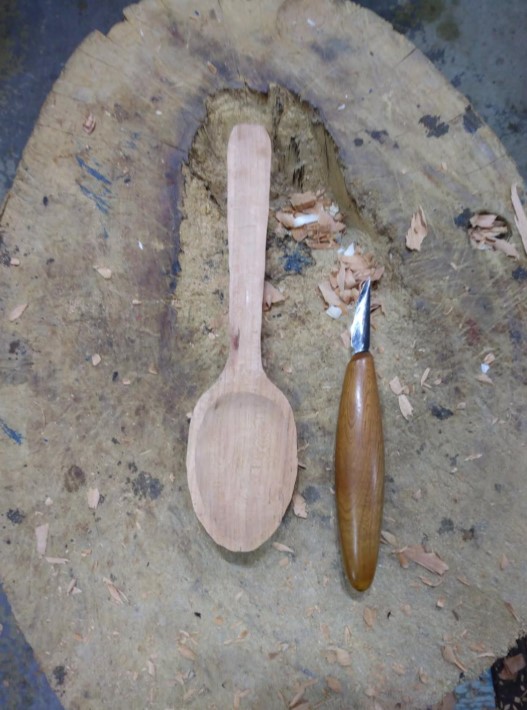
The blank was still pretty thick, so I took my carving hatchet to the end of it, repaired the bowl, now a bit shorter and shallower than I initially intended, and went back to work roughing out the spoon.
It’s drying in the wood chips as I write this. In a few more days, I should be able to fish it out and finish everything up. I’ll approach it a bit more carefully when I do.
I got a request from someone I know to carve some spoons as Christmas gifts for his wife and her sister. He said it would be nice for them to have something to pass down from generation to generation.
And so, it occurred to me that I’ve finally reached the age where someone actually came to me to ask me to create something specifically intended to reach the hands of people I’ll never meet – people who will only know me through my work.
This got me thinking about some of the things that were handed down to me: my father’s anger, my mother’s codependence. My wife and I don’t have any children of our own, so it falls to me to make sure they don’t go any further.
The work’s been long and difficult – a lot more difficult than setting knife to Butternut. It’s a strange thing to find myself in the process of creating new potential heirlooms, while doing my best to remove all traces of a few of the old ones…
I’ve been thinking a lot about community lately. Standing in the workshop, sharpening my knives, and watching a swarm of bumblebees patrolling the Russian Sage, it isn’t hard to stay connected with this.
There’s a recognition in ceremony of those who’ve come before – of objects carried by other hands, and words by other voices. Every time I pick up a blank or a billet, and set to work roughing out a spoon, I’m aware of just how many hands besides my own are touching it.
Almost every tool I used today was a Christmas present from my wife or another member of my family. The Butternut was donated. My Carolinas were also a Christmas present. And even my apron came from a box that showed up when my brother in-law dropped off his Shopsmith.
It’s good to be aware of these things. To let them into the work; let them help in the shaping of it. Let them carry it – and be carried by it – from this set of hands to the next…
I’m at the point in my life where cashiers younger than I am call me “Sweetheart”. Thankfully, I’m also at another point in my life: the one where I can graciously accept it. For a while, I wasn’t sure about this whole getting older thing. It was all kind of weird, actually – sort of a second teenagerhood. I was too young to fraternize with the Elders, and too old to hang around with the young’uns.
But sixty-two has proven to be something of a magic number; almost a kind of sweet spot. My body certainly doesn’t lie; I’m sixty-two not twenty-two. And I occasionally have to rest between rounds of yardwork…especially when the heat index approaches anything north of ninety-five degrees. But instead of catching myself thinking, “Shit, I must be getting old,” as I often used to do, now I simply smile and think, “Well, it’s not like I have a deadline…“
Those of us with garages or sheds that double as workshops understand that free space is a privilege. Mine, for example, is packed to the rafters with odd-sized lengths of various kinds of wood, tubs of billets waiting to be turned into spoons, carving tools, a meager but appropriate assortment of power tools, a lawnmower, a couple semi-retired bikes, a rolling shop table, other bits of assorted stuff too numerous to mention, and a nearly ready-to-braid harvest of this year’s garlic. I’ve gotten used to walking – and working – in there through dedicated practice. It’s easy for things to pile up after a while. Still, with a bit of adjustment, I can find the room to put my feet up with a craft beer or a cup of coffee, look upon my work, and call it good.
There’s a sacredness to the spaces in between things. They’re little doorways that allow the Medicine in. They give us time to rest and breathe, to harvest what was planted in the action, to take it in and let it nourish these bodies of ours which move, perhaps, just a little bit slower these days…
A few days ago, I found myself standing on sacred ground. Not that it isn’t all sacred, of course. But this specific piece of ground carries with it a particularly personal sense of sacredness and grace, as it also happens to be the arbor where we hold the Sun Moon Dance every July.
The Dance itself is one of the teachings passed onto us by Grandfather Joseph Rael (aka Beautiful Painted Arrow). During the course of the Sun Moon Dance, the Dancers move back and forth to a tree at the center of a circular arbor. As they do, they receive the Creator’s descending Light and release it into the world for the highest good of All Our Relations. The ceremony is often difficult, as the Dancers are also conducting a silent fast.
I’ve no way of knowing on a cosmic level what the results of all this might be. However, having danced several times myself, I can honestly say without any exaggeration that this Dance has not only transformed my life, but saved it.
In preparation for this year’s ceremony, a few of us got together to make some well-needed repairs to the arbor. We shored up some timbers and laid in a bunch of new purlins across the top.
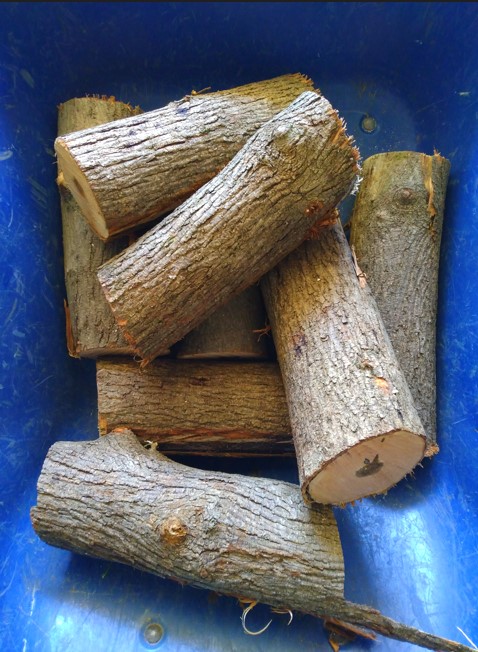
As we gathered for the day’s work, one of the stewards of the land pulled me aside and took me over to where some of the trees had been dropped along the edge of the driveway. A few of my spoons see frequent use in their kitchen, and he’s always quick to offer me some additional material for my craft. This time, I came away with some beautiful cuts of Maple. Overall, there was enough wood for sixteen good-sized billets, which are now sitting in my workshop, patiently anticipating the hook knife and the carving axe.
There’s something deeply rewarding about spending the non-refundable minutes of one’s life in service. It presents us with an opportunity to give back to the Creator – and out to the whole of Creation – the only true currency we really have. Even though some of the blessings we receive might not make themselves readily apparent, others inevitably do. And it is these obvious milestones which keep us moving forward along the path…
I’d planned to get out to the workshop today, but somehow that turned into sitting on the patio and editing the second draft of a writing project I’ve been working on since a year ago last February.
It’s a funny thing, this process of recovery. Learning to sit and allowing the work to proceed of its own accord. Days of deep and soulful stillness following days of wildly untethered ambition. There’s dancing and resting at the heart of it. Putting it out and taking it in. The ebbs and flows of the tides of self-discovery.
The rain is falling a little bit harder now, and there’s more of a wind behind it. At the end of the yard, a Cherry tree spreads itself against the unbroken grey of a cloud-filled sky. Birdsongs and sirens intermingle with the constant patter of raindrops against the awning.
My coffee is empty. My heart is full. And the garden is sufficiently watered…
It’s been a while since I’ve been able to get myself out to the garage and putter around in the workshop. Recent changes in the weather required turning it into a staging area for some new patio furniture, so there was barely enough room for walking out there; let alone tinkering with hatchets and knives or any of the other implements of destruction that have made the place their home.
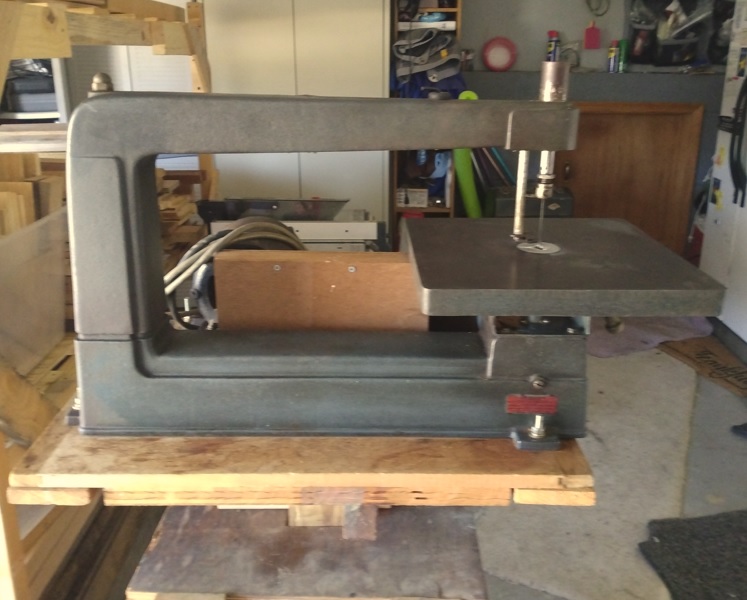
Yesterday, however, the weather shifted a bit, and I was able to put together a new deck box and move the furniture out to the patio. I also rearranged the garage, and set to work sprucing up this old beastie, which I recently rescued from the workshop of close friend who passed away a few years ago.
It’s an old-school, cast-iron Craftsman scroll saw that’s seen its share of use. It’s hefty, clunky, and low tech; and I absolutely adore the thing…for exactly those same reasons. It’s currently sitting atop the platform he built for it, adjusting to its new surroundings. And after a good going-over with a steel Chore Boy and some WD-40, it seems to be settling in just fine.
As an added bonus, someone dropped a couple of small Maple trees right down the street from us. This windfall landed me a nice stack of clean, spooniferous* wood.
I ran the chainsaw through it earlier today, and my plan is to haul out the bandsaw and my carving axe and turn the lot of it into billets later this afternoon.
It’s been an abundant week so far – very little of it planned, but all of it rewarding, none the less.
I fell into a discussion with a fellow traveler a while back about recognizing the work we’re here to do, and how that actually compares to the stories we’ve told ourselves about how our lives should be. This is not to discount the value of planning or the uplifting quality of dreams. And yet, as is often the case, we’ve both come to find that our current lives bare little in common with our past imaginings of them.
“If it lands at your feet, it’s yours to do,” he told me. It’s a philosophy that flies in the face of a culture that often demands of its children an answer to the question, “What are you going to be when you grow up,” and then proceeds to herd them headlong through high school and college, and straight into the workforce, with little or no time for self-discovery.
These days I’ll admit that I’m blessed with a life that reveals itself on an almost moment-by-moment basis. Living this way is not for the faint of heart. Nor is it for those who demand a world that bends to their ideas of how it should be. It’s often unpredictable, and therein lies its Medicine. Having said this, it also readily offers up its own unerring guidance if one can simply listen for it, and answer, “yes…”
*Spooniferous, Adj. – A type of wood – regardless of species – possessing qualities rendering it appropriate for the crafting of wooden spoons.
The weather is unseasonably warm today. There’s also a light rain falling; so even though we’re only into the middle of February, it feels like the perfect afternoon to be out in the workshop rough cutting some wooden spoons.
While I might not be hard at work saving the world, this little corner of it feels pretty good right now. Not that saving the world is something I’m geared for anyway. I’m more about tending to my own wounds and helping others to do the same whenever they come knocking, or whenever Creator points me in their direction.
I’ve learned to stand on these moments of peace when they come. The work has been exhausting lately, and it’s times like this when the results of it can settle into my bones and get me ready for whatever the next round brings.
As I write this, the rain has stopped and the wind’s beginning to pick up. It feels as if the temperature’s starting to drop. I’ll head back out to the garage in a few minutes, listen to a couple more songs, and look upon my work and call it good.
As chaotic as things continue to be right now, this day is exactly the Medicine I needed…
I spent the last couple of days involved in a project and filling an order, which I plan to mail out tomorrow. Today however, my shop sits silently in the aftermath of what might diplomatically be described as my overly expressive technique. It’s the same approach I bring to cooking whenever I’m in the kitchen. It’s loud, frenetic, and messy. It takes no prisoners and suffers no fools… save one.
And yet, there’s a kind of stillness at the center of all this chaos. It’s not something I actively seek to attain; rather, it arises by itself once everything else has surrendered to the noise. For me, whether crafting or cooking, it’s simply a matter of arming myself appropriately and charging headlong into the fray; immediate surroundings and faint-hearted onlookers be damned.
And while my writing typically runs much in a similar vein, today I ‘m wrestling with images trying to get out, and words that seem hellbent on refusing to let them. There are threads here, without a doubt, but weaving them into a cohesive fabric is another matter entirely. Still, despite all my efforts to the contrary, something sat me down and demanded I write.
So here I sit, trying to honor that in my own humble way.
I’ve been thinking a lot lately about the notion of process and how it applies to carving; more specifically, how it applies to carving spoons. From tree, to log, to billet, to blank, to rough-cut, to wooden spoon, the act of carving is one of constant refinement; of stripping away the excess material and revealing that which it obscured.
And even then, the process still continues. Once the tools have been put away, the spoon is oiled and burnished. For those unfamiliar with the term, burnishing is the act of rubbing the spoon with a smooth object like a pebble, antler, or polished round of wood. This closes the pores and takes away any remaining rough spots. After that, the spoon is oiled again and set aside to cure.
It might be tempting at this point to call the whole thing done and dusted. But in a way, for the spoon, the real work is just beginning. And that work will continue to shape the spoon for rest of its life.
How many of us have held a wooden spoon that’s outlived the relative who passed it down only to notice the patina it’s acquired from decades of nearly constant use in soups, sauces, or chillis? The scratches, burn marks, dents, and flaws that only serve to add to its character and shape it into something mythic; each little mark telling the story of the one who put it there. It’s in this way, that something created to serve a specific purpose continues to find itself remade by the very act of doing so…



 Bonja the Bodger