You never know where your decisions will take you.
For instance: standing in the garage on that chilly January morning, fashioning the bowl of an extremely crude spoon with my very first hook knife a little over seven years ago, I would never have expected that someday I would receive an invitation to talk about how the craft of spoon carving had influenced my own personal recovery and my spiritual healing work with others.
But that is exactly what happened on Easter Sunday.
In addition to being a very good friend, Jim Houck, the host of “Reclaiming Authenticity”, is also a counselor and a deeply dedicated spiritual practitioner.
I’ve decided to set this interview adrift with the sincere hope that those who find it receive as much from listening to it as I did from participating in the experience itself…
Laying down the foundation for a shed. Mowing the lawn. Loosening the soil in the garden. Pruning the Pennsylvania Cherry. Setting out the furniture on the patio…
And afterwards?
Looking upon my work and calling it good.
Days like this are necessary. Little portions of “Yeah.” and “Why not?” sandwiched in between the deep and often difficult bouts of recovery.
Work and rest.
Work and rest.
Feeling the sacred balance of it settling into my bones. To say I’m completely comfortable with the simplicity of it all would be a stretch; but most days it comes and goes however it needs to, and I can somehow manage to let it breathe…
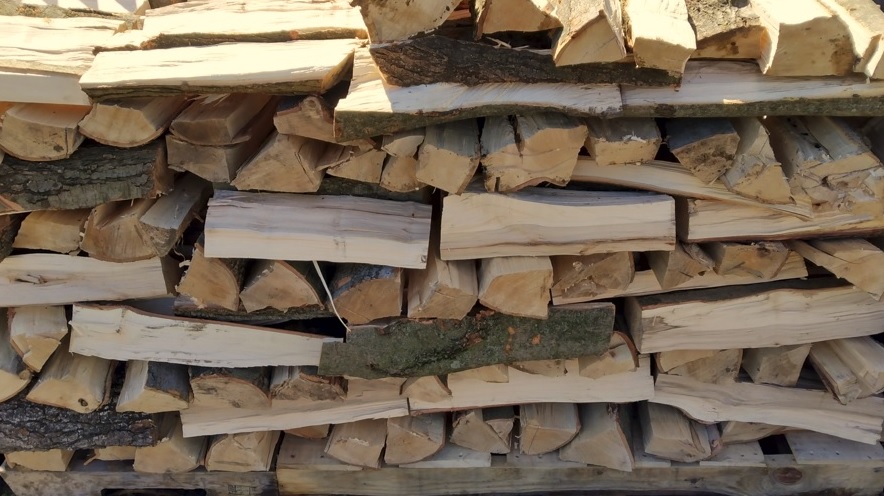
The splitting and stacking wrapped up earlier than I estimated it would. All told, I ended up with a little more than half-a-cord of pristine Silver Maple for the fire.
I found it piled out by the curb in front of a house I’d passed on one of my evening walks around the neighborhood; yet another indication of just how abundant my life currently seems to be.
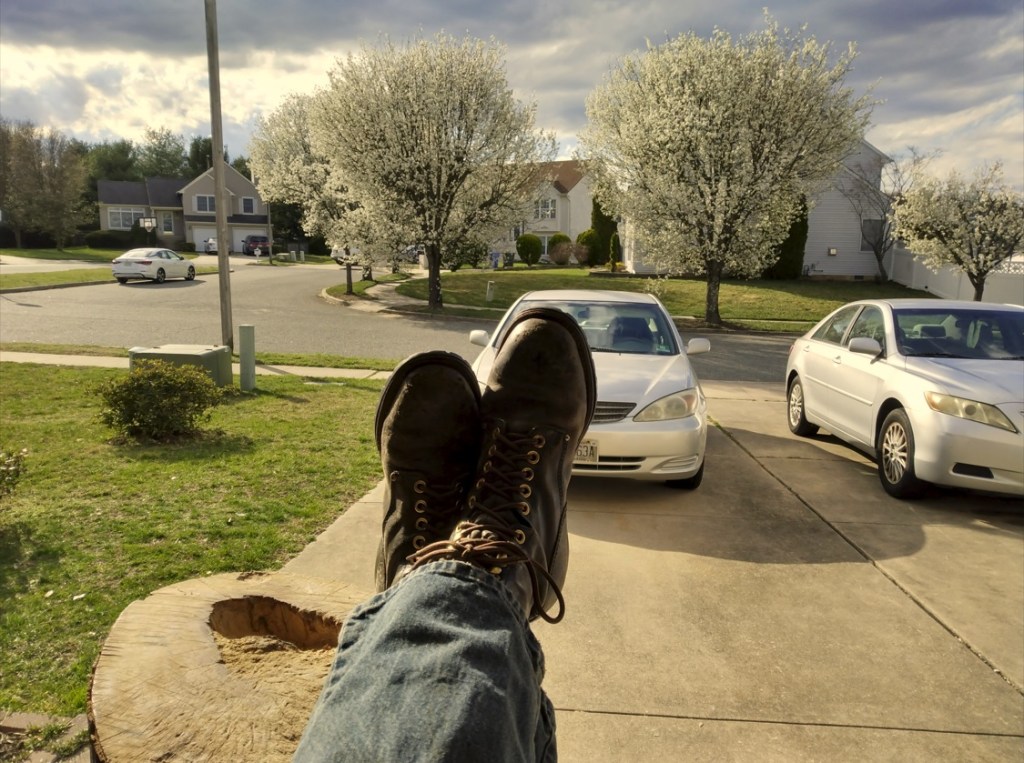
I’m not really sure of where this is all headed, and I don’t actually feel as if I need to know. For now, it’s a chilly Sunday afternoon, the ornamental Pear trees across the street are blooming as if someone dared them to, and I’m sitting in my woodshop listening to Tom Waits, completely aware of every single bit of it…
After the tools have been packed away, the rags folded, and the floor of the woodshop swept, I kick back and slide into the quiet satisfaction of a day well-spent.
Sometimes there’s a coffee, sometimes a beer, but always there is music and the recognition of just how good it feels to sit here having made something useful with my hands.
To be honest, as much as I love the process of carving a spoon, it often seems as if it’s simply done in preparation for the long, slow, nourishing moments that follow…
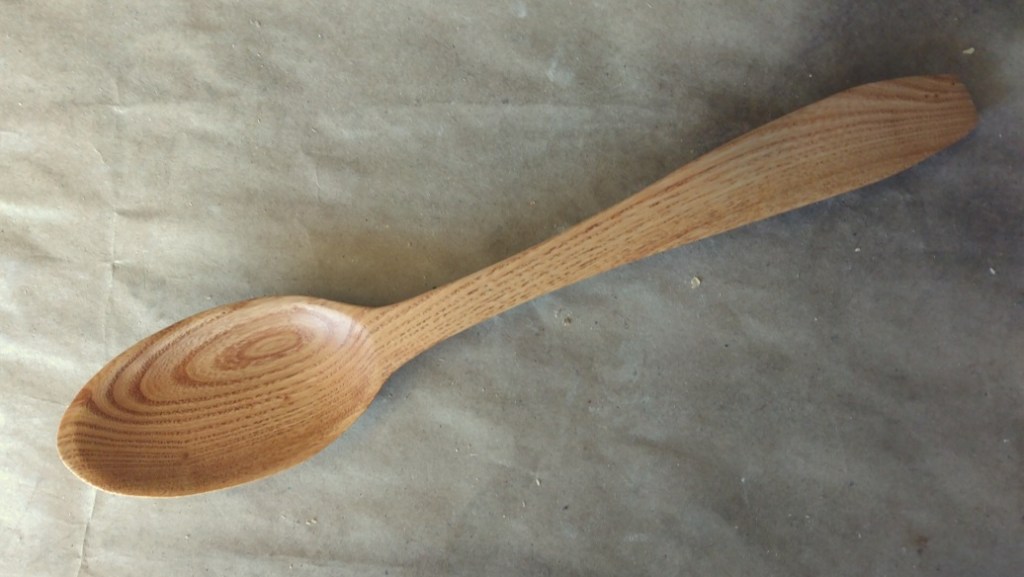
I spent the day finishing up a commission piece for a very generous patron who wanted “a longer spoon with grain you can see.” I went with Butternut because the grain is prominent anyway, but I also rubbed it down with cinnamon before I burnished it. During this process, the cinnamon imbeds itself into the grain and really makes it pop, especially with a lighter wood like Butternut.
I always appreciate when commission work comes around. It’s a blessing when someone basically says, “Hey, you know that thing you really love to do? Well, how about you go and do it for me?” And I’m especially grateful when that also happens to involve working in the shop with the door wide open on a beautiful, warm, just-about-spring day.
Between the carving, the music, the weather, and the occasional wave or chat with one of my neighbors, I couldn’t have asked for a better afternoon.
There’s an obvious pattern of abundance in my life lately. Though perhaps it’s more appropriate to say that I’m finally becoming more keenly aware of the abundance that’s always been here, but often times has simply gone unnoticed…
Now that the weather has started to break, I’m back to evening walks around the neighborhood.
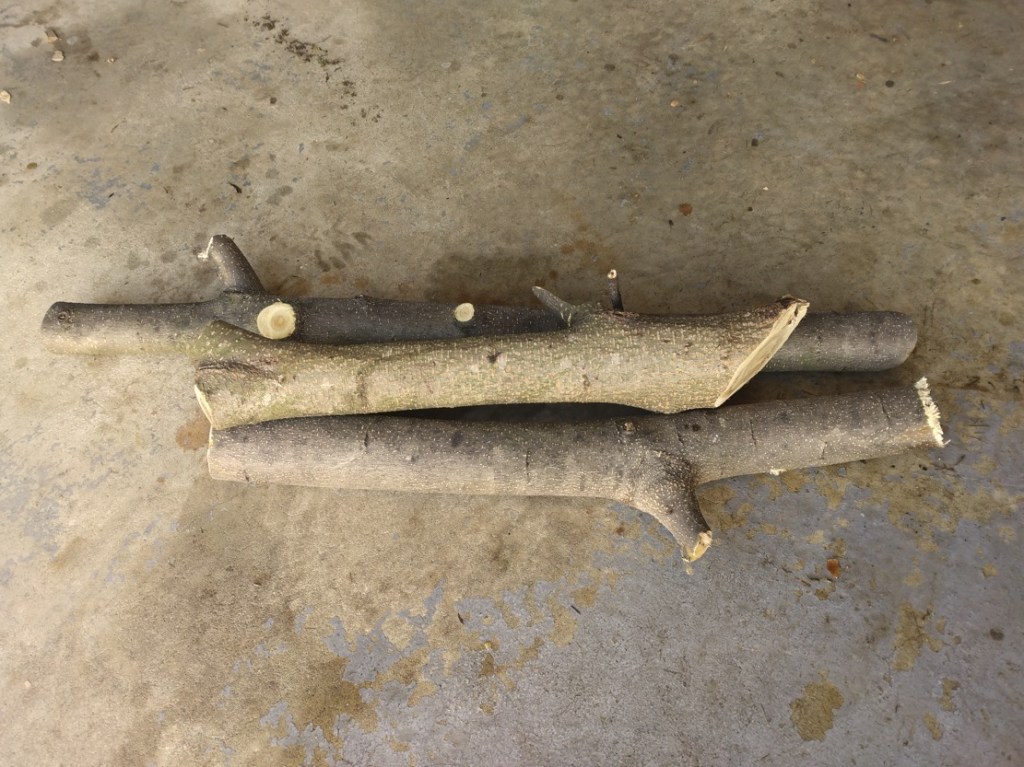
Last night I noticed some pieces of Peach wood buried amongst a pile of branches left by the side of the road after some of the trees in a local orchard had been pruned.
I’ve never worked with Peach before and this is a little bit narrower than I’m used to; but it’s still pretty green, so I’ll billet it up and get it under water until an appropriate project presents itself.
I’m learning to work with what’s in front of me these days; focusing less on outcomes and more on processes. It’s only taken a little shy of sixty-one years to get here. All things considered, I’d say that’s pretty good…
I finally tuned up the kerosene heater and crawled out from under the cold or whatever it was I’d been dealing with for the last two weeks. It feels good to be back in the shop again, putting my tools to use.
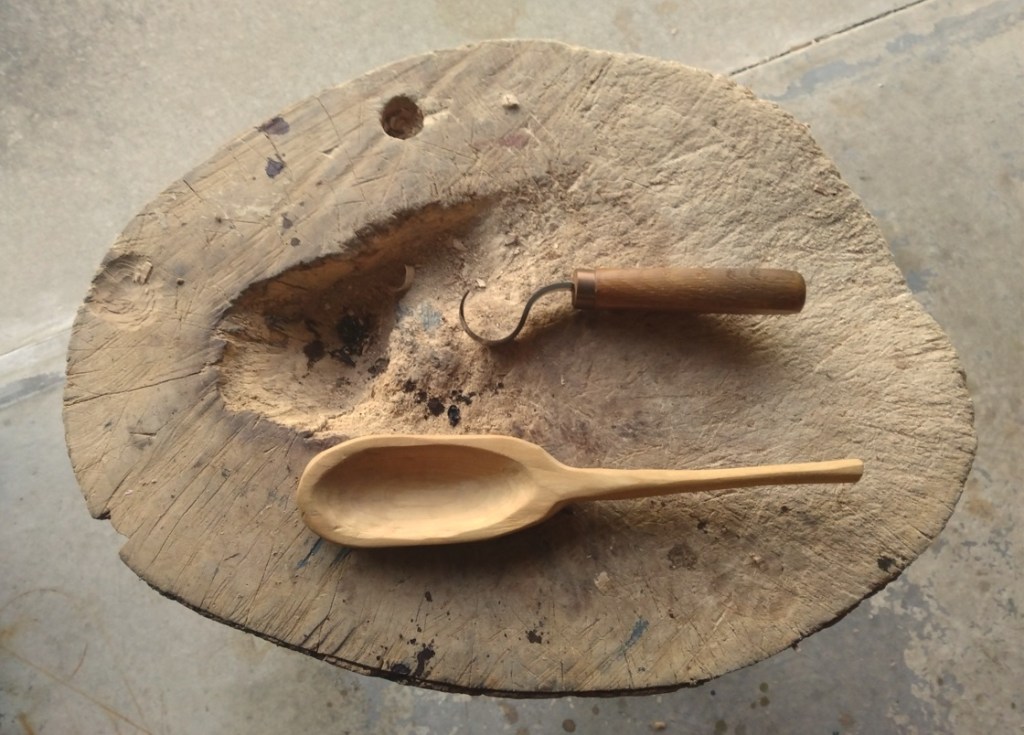
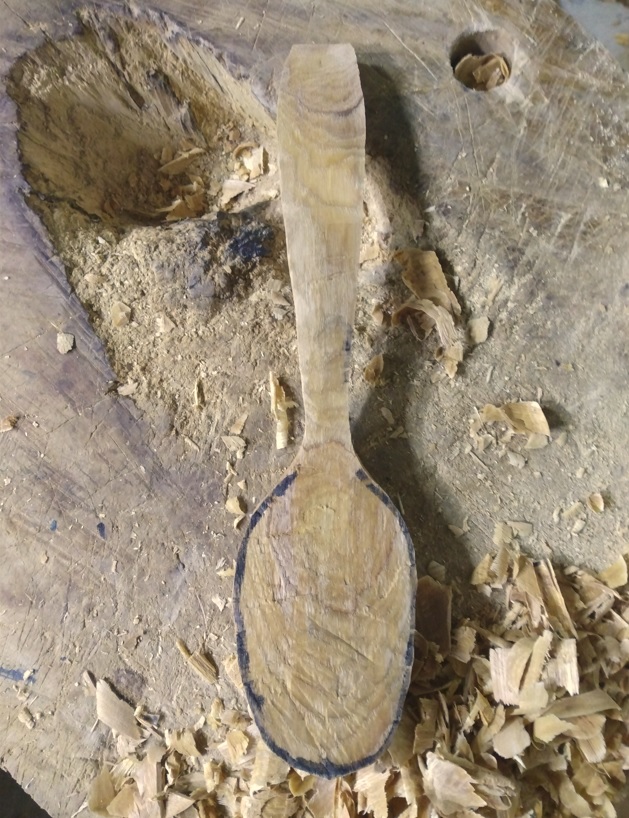
I usually try to finish my spoons as soon as they’re dry enough but lately it’s been more about the rough cuts. There’s at least a half a dozen ready to go. They’re waiting – almost patiently – in the wood chips. It’s like they know there’s warmer weather in the forecast, and they’d rather make their first appearance in the open air and sunshine.
So I hunker down and do the work that’s in front of me.
I’m coming to recognize the importance of letting things dictate their own pace and not pushing the river, as it were. The willingness to live this way isn’t something that’s come easy to me for the greatest portion of my life, but I really seem to be taking to it these days…
If some of the conversations I’ve had with fellow spoon carvers are any indication, it seems that more than a few of us have one hanging around their shop somewhere…if not, as in my case, on the wall of their living room. I carved my own rat-tailed bathtub – seen here on the left – just a little over seven years ago. It was January 19th, 2017 to be exact. I know this because I wrote the date on the back of it in pencil and I can still just barely make it out.
Most of my tools were crude and cheaply made. And although I’d had some very generous and patient tutelage from a friend of mine and a couple of veterans online, I’d had no formal training whatsoever. And so I set to work as best I could, slicing away chips of wood and hunks of skin with almost equal fervor.
Compared with one of my more recent spoons on the right, finished just before last Christmas, it’s obvious that the result of my first attempt at spoon carving is as much a victim as it is a product of the external forces that shaped it. And yet I remember being very proud of it at the time. To be honest, I still am in a way. While I could go back and retool it a bit, I prefer to keep it as it is. It reminds me to let the process do its thing; to allow the material and the carving tools to guide me; and to remember that sometimes the spoon itself has the final say as to how it all turns out.
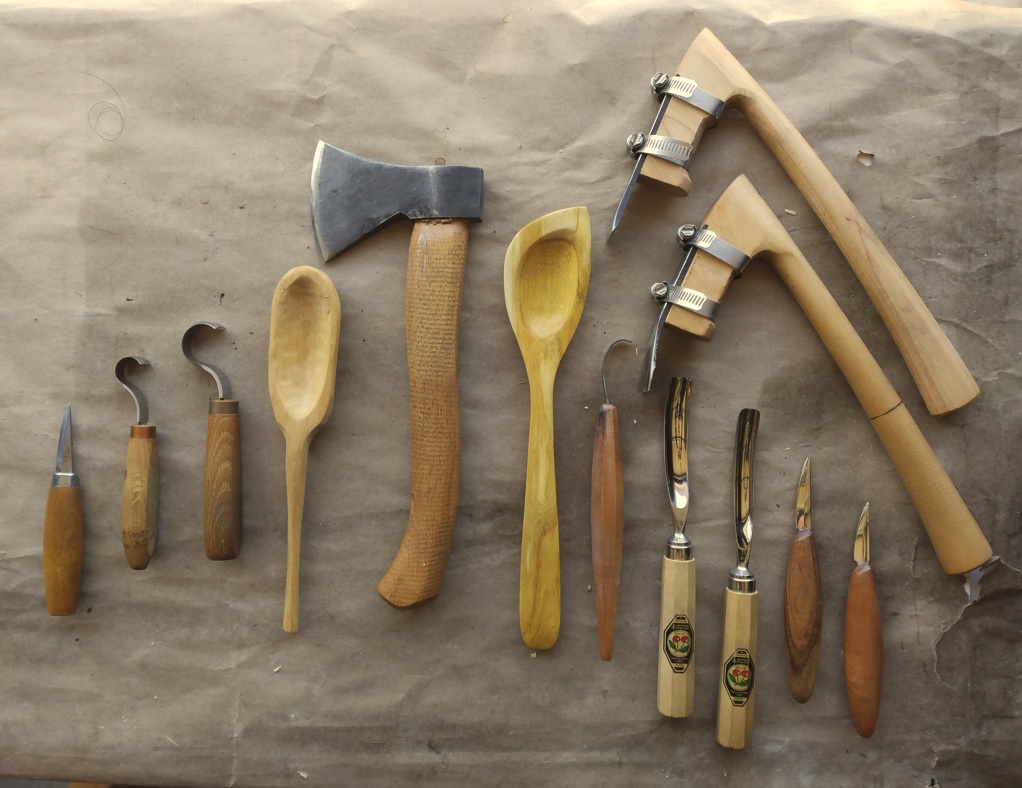
In the years that have followed since that first cold morning huddled next to a struggling electric heater in a cluttered garage that would soon become an only slightly less cluttered woodshop, the number and quality of tools at my disposal has grown. Most, in the vernacular, are “Big BoyTools”, and as one might expect they allow for more refined work. And yet despite their craftsmanship, they are sometimes quick to remind me that without constant attention to the quiet and often demanding voice of the wood itself, they are at heart little more than highly sharpened pieces of steel ready to teach me the importance of that lesson.
There’s humility gained in the unfolding of this work, and a scar or two to mark the achievement of it.
And also there is a sense of continuity. Like the hatchet between the spoons in the picture, the edge of which has touched practically every single spoon I’ve ever carved, there’ s a certain sense of discovery and child-like abandon that has carried everything along from the beginning…
Last night we had our first measurable snowfall of the season; perhaps an inch-and-a-half, perhaps two. It could hardly have been called an event compared with the storms I’d routinely experienced as a child growing up in Northeast Pennsylvania. But even this modest amount serves as a reminder that we are truly in the midst of winter; “the placewhere the White Giant sleeps,” as a beloved adopted Grandfather often reminded us.
In our telling of the Medicine Wheel, winter sits in the direction of the North, the place of childlike innocence and teachability. Traditionally, the long winter was the time to sit at the feet of our elders, to listen to their stories, and to eat the fruits of the past year’s labors while the snows fell and the winds mourned the death of living things. This is a season of reflection and purification, where the old things are broken down or swept aside to feed and make way for the new.
There’s a great deal of Mystery in all of this. Despite our best efforts to shape and define our existences, we can never fully anticipate what will be revealed once the snows recede and the first slender whisps of green emerge.
And yet we feel the pull of it; the arrival of something drawing us towards itself with a force as irrefutable as it is ineffable…
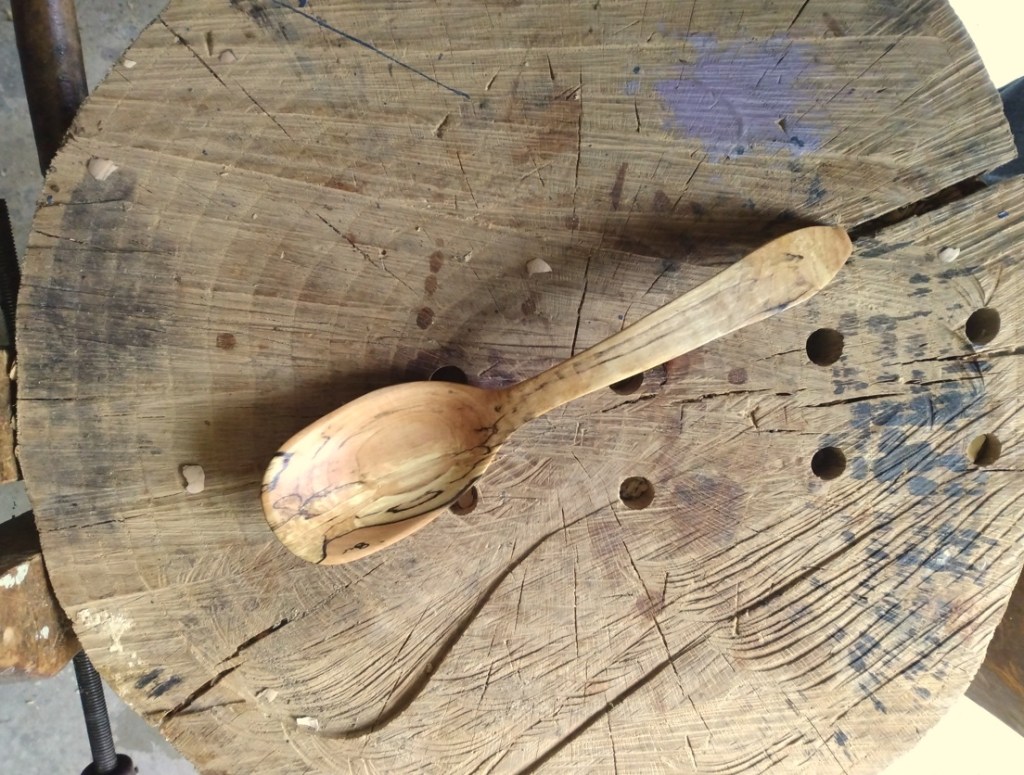
The intricate patterns and discoloration seen in this Beechwood spoon are the result of a process known as spalting, which occurs when an external fungus growing on the surface of a dead tree sinks its tendrils deep into the fiber of the wood in order to feed itself. Aside from potentially weakening the structure of the wood, spalting also causes the type of patterning displayed here when those tendrils create an armor of protein for protection.
It’s interesting to note that spalting can also occur in living trees experiencing some type of environmental stress. Exposing the wood to sunlight kills the process but leaves behind the colorful and obvious traces of its work. Because of this, spalted woods are highly valued and sought after by artists and woodworkers alike.
Those of us who’ve survived the stresses of growing up in households afflicted by alcoholism, codependency, or some other form of dysfunction often seem to experience a similar process. As children, we’re unable to resist the influences of the sickness in our environment, and so it reaches deep inside us and takes root. It lives there, marking us, and affecting the patterns of our lives in ways which serve to anchor it and keep it fed.
Through our healing and recovery work, we open ourselves up and expose these things to the light of realization. When we do, their influence over us slowly begins to die.

 Bonja the Bodger