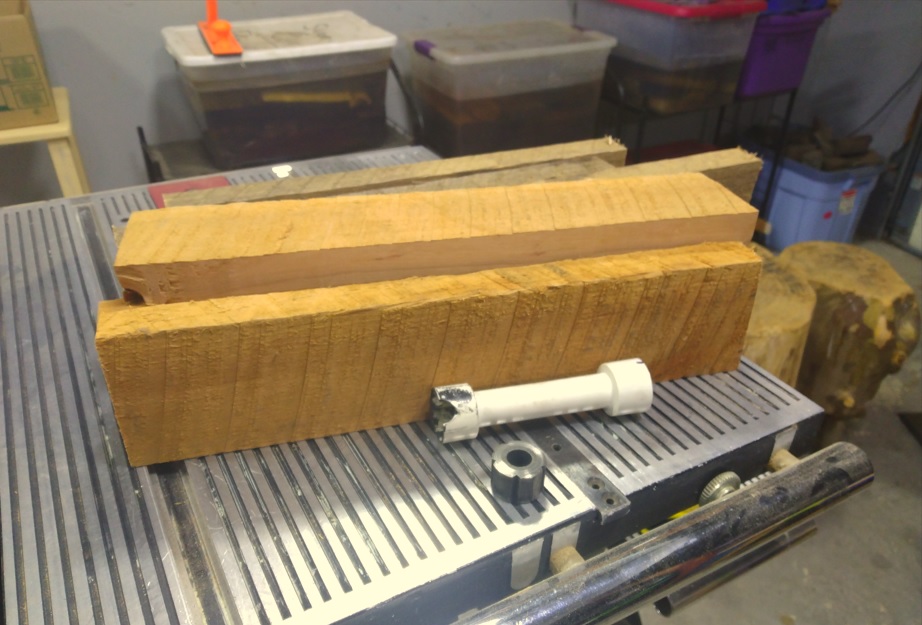
I picked up a few requests over the holiday, so I’m out in the garage, cutting some Cherry and Butternut blanks, and getting to work on the initial steps of bringing an antique handaxe back to life.
The heater’s finally taken the edge off the chill, and the workshop’s warm and welcoming; it’s the perfect day to be out here with my tools, enjoying the space that inevitably opens up after the blissful chaos of the annual celebrations.
I’m reminded, in the silence of this space, of the feeling of sitting on the beach when the waves have withdrawn. There’s an openness to it; and a deep and palpable grace that only comes from the knowing and accepting of its impermanence…
I guess it’s a good idea to go back to the beginning.
Lately, I’ve been watching some videos on YouTube where a bunch of guys have been touting some inexpensive axes from Harbor Freight. The story goes that with a little tweaking, these bad boys can become a fairly decent camp axe. I’ve always wanted to try my hand at something like this, and at just under twelve bucks a pop, I figured I had nothing to lose.
I won’t go too heavily into the details; there’s a ton of videos out there explaining the process, so there’s no need for me to reinvent the wheel. But the upshot is that the videos I’ve been watching do seem pretty accurate.
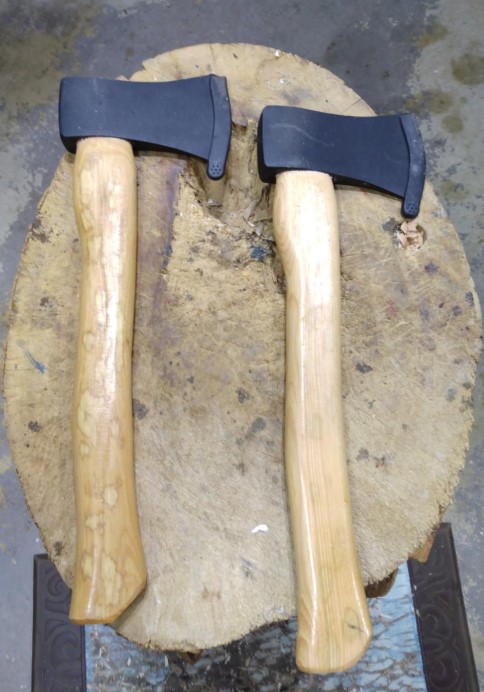
Here’s a picture of what I started out with:
First, I removed the stickers and sanded the varnish off the handles. I left them rough to ensure a better grip. Then I drilled each of them out to accommodate a lanyard. I’ll be using paracord for this, but I don’t have any on hand, so I’ll attach the lanyards later, when it comes in.
After sanding the paint off the heads of the axes, I got to work reprofiling them with a rag and Bastard file. They were pretty thick, so I thinned them out and lengthened the cutting edges. When that was done, I ran them across some diamond sharpening pads and took them down to 3200 grit.
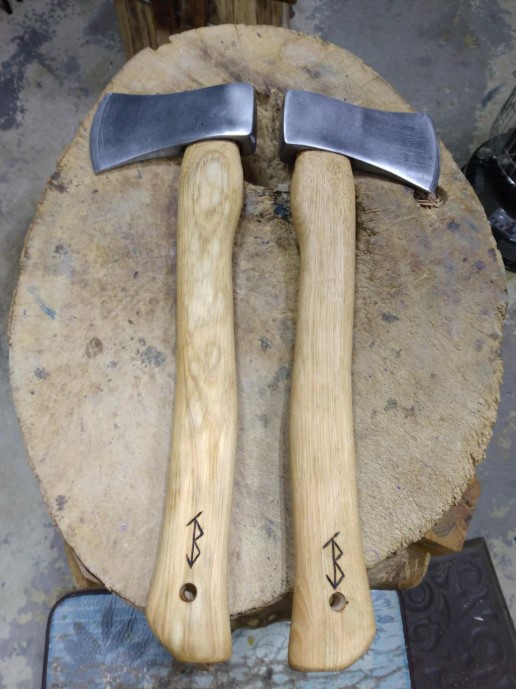
Once they were sufficiently sharpened, I burned in my maker’s mark and oiled the handles.
They’re drying on my carving block in the workshop, and I’m really looking forward to testing-driving them when I get the chance.
Overall, I’d say it was a pretty good way to spend a Sunday afternoon…
Yesterday, we gathered for a ceremony in the back yard while most of the rest of the civilized world 9-5’ed. As is generally the case whenever we get together, our focus quickly turned to the state of the world.
Our conversations are usually free-form and heavily seasoned with laughter and wry observations. That’s not to say our ceremonies are unstructured or lack direction. The form is there, though largely marbled through the meat, instead of plastered over it like a cast. There’s a necessary sacredness in coming together with laughter, especially in a world which seems to base so much of its existence upon cruelty, greed, conflict, and fear.
Eventually, we got around to the topic of peace, and how we might bring a little more of it into the world. As a great deal of our work is based upon the Medicine Wheel – or at least the version presented to us in the teachings of Grandfather Joseph Rael (aka Beautiful Painted Arrow) – I attempted to approach the question from this perspective.
The path of the Wheel begins in the East, with the rising of the sun. From there it follows the sun through the sky as it passes into the South, West, and North.
Agriculturally speaking, the East is where the seed is planted.
In the South, the garden is tended. It’s a time of expectation and uncertainty. Will there be too much rain or too little? Will the temperatures run to extremes? Will there be enough food for us all come the harvest? Will we have to deal with insects, deer, or rabbits?
In the West, the questions fall away, and the results are gathered in. We fill the cupboards and begin the necessary preparations to take us through the winter.
In the North, the long, dark time of howling winds, warm fires, and taking stock of the past year’s endeavors, we sustain ourselves on whatever we’ve put aside. If we planted good and healthy crops during the spring, that’s what will feed us as the snow piles up and the windowpanes rattle. If, instead, we’ve planted weeds and thorns, then that will be the source of our nourishment for the winter.
Perhaps, then, the process of peace begins with asking what we’d like to feed ourselves and our loved ones with and simply planting it. We can’t transform the crops once they’re in the ground, but we can learn to pay attention to the seeds we’re sewing.
It’s a blessing to have these things in our lives: fruitful and light-hearted conversations with the Elders of our tribe, an afternoon to sit and write after a morning of errands, pruning the squash vines, and removing the surface rust from a jointer.
Maybe this is how we sew a little peace into our corner of the field…
In working through the often-arduous processes of my spiritual healing and emotional recovery, I’ve been blessed to have found myself in the presence of Elders who’ve taught me about the practice of putting our prayers on the wind. When we do this, we speak these things out loud so that, like seeds, they might take flight, land on fertile ground, sink deep roots, and potentially grow into something that feeds us all.
While I’ll never claim to speak for anyone else, my personal belief is that it’s necessary to discover whatever it is we’re here to do…and to do it. It’s not like toting it around in your pocket, pulling it out when you need it, and putting it back when you’re done. It’s saying yes to something that shapes our very lives; changes us into the vessel it needs to bring it out to the People…
I’m at the point in my life where cashiers younger than I am call me “Sweetheart”. Thankfully, I’m also at another point in my life: the one where I can graciously accept it. For a while, I wasn’t sure about this whole getting older thing. It was all kind of weird, actually – sort of a second teenagerhood. I was too young to fraternize with the Elders, and too old to hang around with the young’uns.
But sixty-two has proven to be something of a magic number; almost a kind of sweet spot. My body certainly doesn’t lie; I’m sixty-two not twenty-two. And I occasionally have to rest between rounds of yardwork…especially when the heat index approaches anything north of ninety-five degrees. But instead of catching myself thinking, “Shit, I must be getting old,” as I often used to do, now I simply smile and think, “Well, it’s not like I have a deadline…“
Those of us with garages or sheds that double as workshops understand that free space is a privilege. Mine, for example, is packed to the rafters with odd-sized lengths of various kinds of wood, tubs of billets waiting to be turned into spoons, carving tools, a meager but appropriate assortment of power tools, a lawnmower, a couple semi-retired bikes, a rolling shop table, other bits of assorted stuff too numerous to mention, and a nearly ready-to-braid harvest of this year’s garlic. I’ve gotten used to walking – and working – in there through dedicated practice. It’s easy for things to pile up after a while. Still, with a bit of adjustment, I can find the room to put my feet up with a craft beer or a cup of coffee, look upon my work, and call it good.
There’s a sacredness to the spaces in between things. They’re little doorways that allow the Medicine in. They give us time to rest and breathe, to harvest what was planted in the action, to take it in and let it nourish these bodies of ours which move, perhaps, just a little bit slower these days…
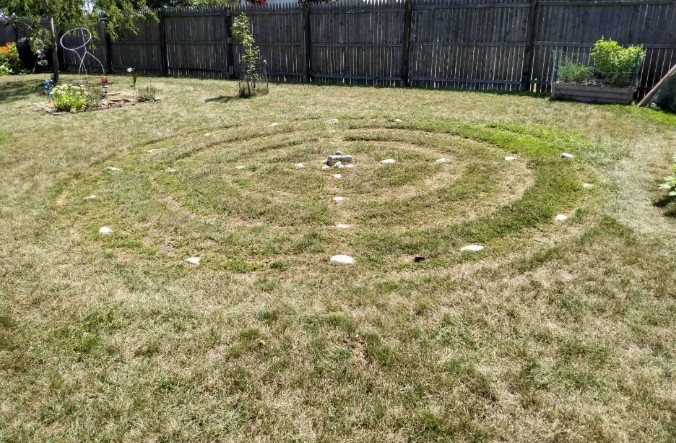
A few days ago, I found myself standing on sacred ground. Not that it isn’t all sacred, of course. But this specific piece of ground carries with it a particularly personal sense of sacredness and grace, as it also happens to be the arbor where we hold the Sun Moon Dance every July.
The Dance itself is one of the teachings passed onto us by Grandfather Joseph Rael (aka Beautiful Painted Arrow). During the course of the Sun Moon Dance, the Dancers move back and forth to a tree at the center of a circular arbor. As they do, they receive the Creator’s descending Light and release it into the world for the highest good of All Our Relations. The ceremony is often difficult, as the Dancers are also conducting a silent fast.
I’ve no way of knowing on a cosmic level what the results of all this might be. However, having danced several times myself, I can honestly say without any exaggeration that this Dance has not only transformed my life, but saved it.
In preparation for this year’s ceremony, a few of us got together to make some well-needed repairs to the arbor. We shored up some timbers and laid in a bunch of new purlins across the top.
As we gathered for the day’s work, one of the stewards of the land pulled me aside and took me over to where some of the trees had been dropped along the edge of the driveway. A few of my spoons see frequent use in their kitchen, and he’s always quick to offer me some additional material for my craft. This time, I came away with some beautiful cuts of Maple. Overall, there was enough wood for sixteen good-sized billets, which are now sitting in my workshop, patiently anticipating the hook knife and the carving axe.
There’s something deeply rewarding about spending the non-refundable minutes of one’s life in service. It presents us with an opportunity to give back to the Creator – and out to the whole of Creation – the only true currency we really have. Even though some of the blessings we receive might not make themselves readily apparent, others inevitably do. And it is these obvious milestones which keep us moving forward along the path…
I’d planned to get out to the workshop today, but somehow that turned into sitting on the patio and editing the second draft of a writing project I’ve been working on since a year ago last February.
It’s a funny thing, this process of recovery. Learning to sit and allowing the work to proceed of its own accord. Days of deep and soulful stillness following days of wildly untethered ambition. There’s dancing and resting at the heart of it. Putting it out and taking it in. The ebbs and flows of the tides of self-discovery.
The rain is falling a little bit harder now, and there’s more of a wind behind it. At the end of the yard, a Cherry tree spreads itself against the unbroken grey of a cloud-filled sky. Birdsongs and sirens intermingle with the constant patter of raindrops against the awning.
My coffee is empty. My heart is full. And the garden is sufficiently watered…
It’s been a while since I’ve been able to get myself out to the garage and putter around in the workshop. Recent changes in the weather required turning it into a staging area for some new patio furniture, so there was barely enough room for walking out there; let alone tinkering with hatchets and knives or any of the other implements of destruction that have made the place their home.
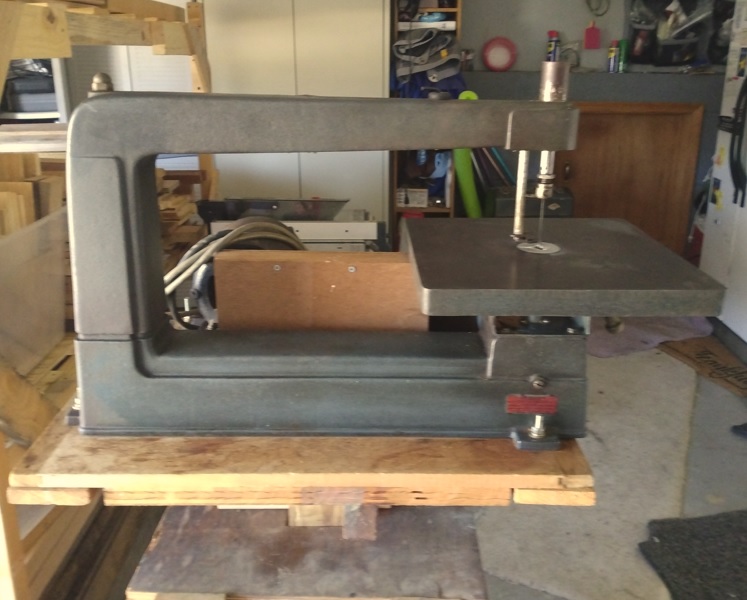
Yesterday, however, the weather shifted a bit, and I was able to put together a new deck box and move the furniture out to the patio. I also rearranged the garage, and set to work sprucing up this old beastie, which I recently rescued from the workshop of close friend who passed away a few years ago.
It’s an old-school, cast-iron Craftsman scroll saw that’s seen its share of use. It’s hefty, clunky, and low tech; and I absolutely adore the thing…for exactly those same reasons. It’s currently sitting atop the platform he built for it, adjusting to its new surroundings. And after a good going-over with a steel Chore Boy and some WD-40, it seems to be settling in just fine.
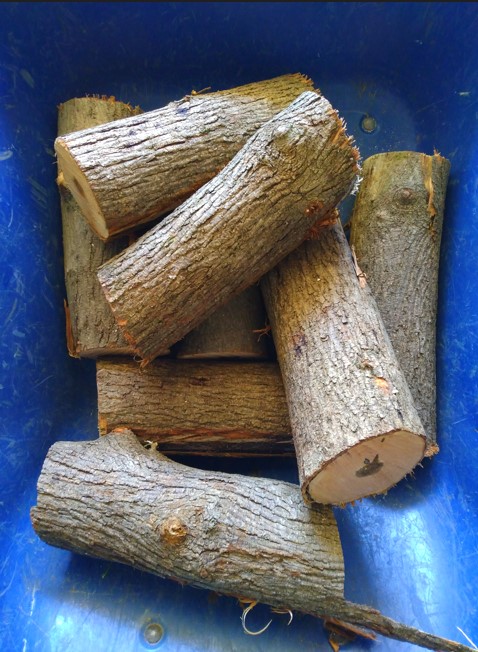
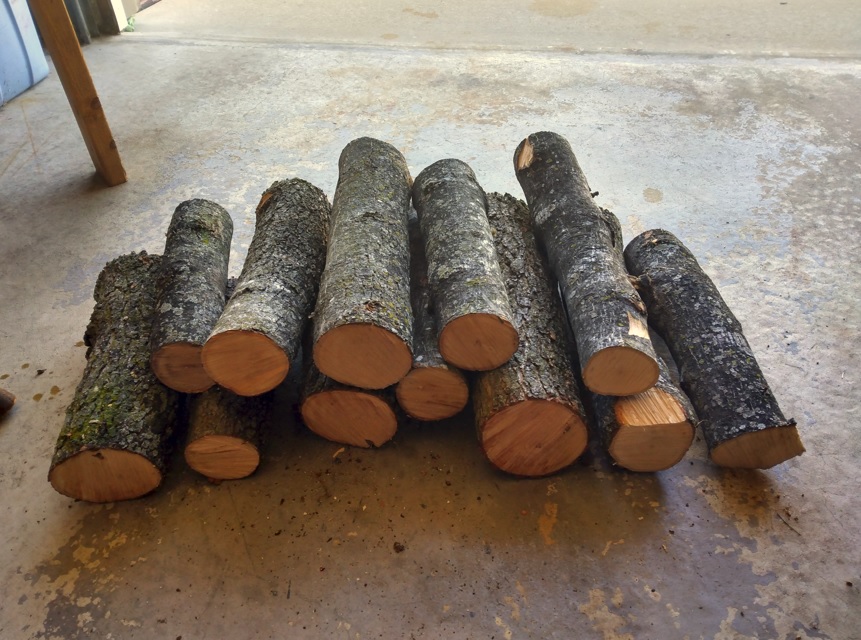
As an added bonus, someone dropped a couple of small Maple trees right down the street from us. This windfall landed me a nice stack of clean, spooniferous* wood.
I ran the chainsaw through it earlier today, and my plan is to haul out the bandsaw and my carving axe and turn the lot of it into billets later this afternoon.
It’s been an abundant week so far – very little of it planned, but all of it rewarding, none the less.
I fell into a discussion with a fellow traveler a while back about recognizing the work we’re here to do, and how that actually compares to the stories we’ve told ourselves about how our lives should be. This is not to discount the value of planning or the uplifting quality of dreams. And yet, as is often the case, we’ve both come to find that our current lives bare little in common with our past imaginings of them.
“If it lands at your feet, it’s yours to do,” he told me. It’s a philosophy that flies in the face of a culture that often demands of its children an answer to the question, “What are you going to be when you grow up,” and then proceeds to herd them headlong through high school and college, and straight into the workforce, with little or no time for self-discovery.
These days I’ll admit that I’m blessed with a life that reveals itself on an almost moment-by-moment basis. Living this way is not for the faint of heart. Nor is it for those who demand a world that bends to their ideas of how it should be. It’s often unpredictable, and therein lies its Medicine. Having said this, it also readily offers up its own unerring guidance if one can simply listen for it, and answer, “yes…”
*Spooniferous, Adj. – A type of wood – regardless of species – possessing qualities rendering it appropriate for the crafting of wooden spoons.
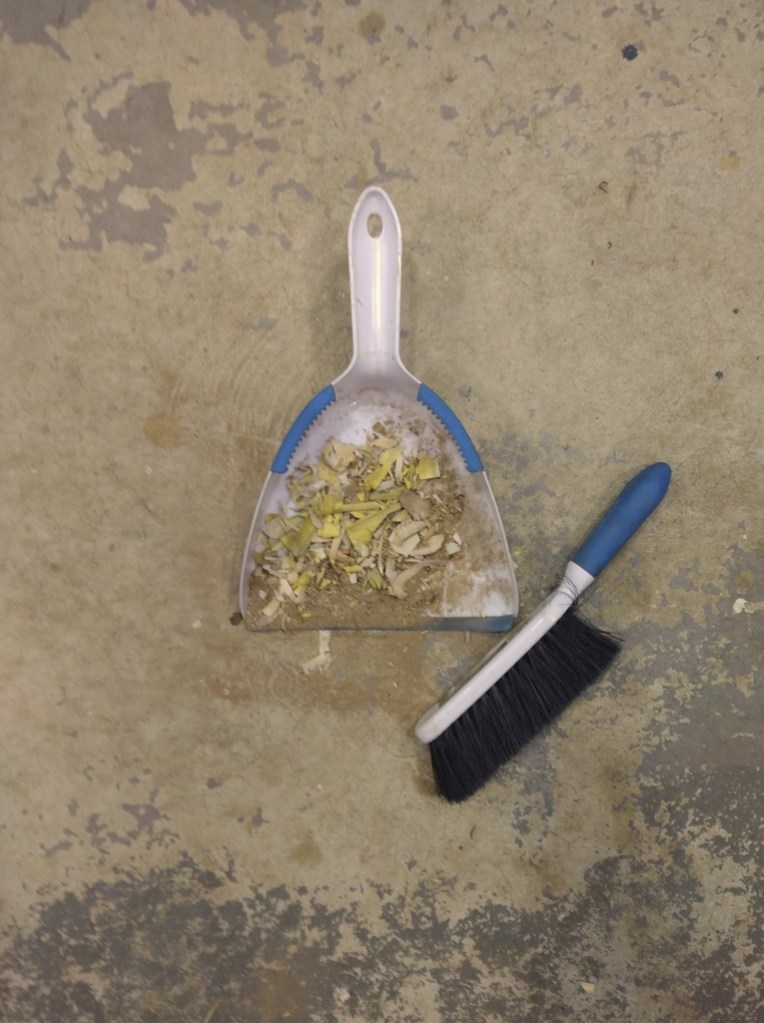
Well, the latest run of Arctic weather seems to have finally broken. And while it’s nowhere near what anyone in their right mind would consider balmy, this afternoon was still warm enough to fire up the kerosene heater and give the garage a thorough going over with a Shop-Vac and a broom. It was starting to become unpassable, so it felt good to be able to get out there and disentangle the log jam of power tools, projects, and scrap wood.
In his teachings on the Medicine Wheel, Grandfather Joseph Rael (aka Beautiful Painted Arrow) tells us that Winter is the season of childlike innocence and teachability. It’s the time when we lay low, share stories with one another, and reflect upon the workings of the past year.
It’s also when we empty the cupboards of the things we’ve put aside to nourish ourselves through the long, cold months of snow and darkness. In doing so, we begin to make room for next year’s provisions, which in turn will carry us through the following Winter.
There’s a lot to be said for this process of making room; not only of sweeping up the dust and remnants of assorted projects and tossing it all away, but of taking stock and nourishing ourselves on the wisdom of our accomplishments; of letting go of the people, places, things, and habits which no longer serve us – grateful for their having kept us going in the past, but recognizing, too, their tendency to keep us rooted there…
I recently purchased some new parts for my Shopsmith; nothing major, just a couple of random bits that, much like some of those belonging to machine’s operator himself, had finally gotten around to showing some signs of aging. Unlike my own random bits, however, I was able to order replacements for them quickly and cheaply online.
This little setback, coupled with below freezing temperatures – rendered even colder by nearly constant winds – has kept me out of the workshop for the last few days. “Screws fall out all the time;” Judd Nelson’s John Bender tells us in the 1985 movie, The Breakfast Club,” the world’s an imperfect place.”
As to whether or not the falling out of screws and other apparently random events signify an imperfect world, poised to self-destruct without notice at any given moment, or a perfect one, in which evolutionary forces ensure that things which no longer serve are constantly replaced by newer, more efficient ones, I’ll leave to the philosophers to decide.
For now, it’s enough to know that the process exists, and we – or at least some of our random bits – are apparently subject to it…


 Bonja the Bodger